

Sommaire
Do fungi communicate with plants? What soil networks reveal
Do fungi really communicate with plants? The short answer is yes, but not like two neighbors chatting over coffee. In the soil, the mycelium of certain fungi connects roots, facilitates resource exchanges, and can participate in the circulation of chemical signals. Mycorrhizae are at the heart of this discreet but essential relationship for the life of many ecosystems.
The subject fascinates, sometimes to the point of overlooking an important nuance: talking about “plant communication” is a useful metaphor, provided we do not attribute human intentions to plants or fungi. Here is what science allows us to understand about soil networks, what is well documented, and what remains debated.
In brief
🍄 Mycorrhizae associate the roots of a plant with the mycelium of a fungus. This cooperation notably allows exchanges between carbon produced by the plant and water or mineral elements captured from the soil.
🌱 A single fungal network can sometimes connect several plants. Transfers of resources and signaling molecules have been observed under certain experimental conditions.
🧪 The term “social network of trees” greatly oversimplifies the phenomenon. The real extent of exchanges, their frequency, and their benefit for each plant vary depending on species, soil, climate, and the fungus involved.
Are fungi connected to plants underground?
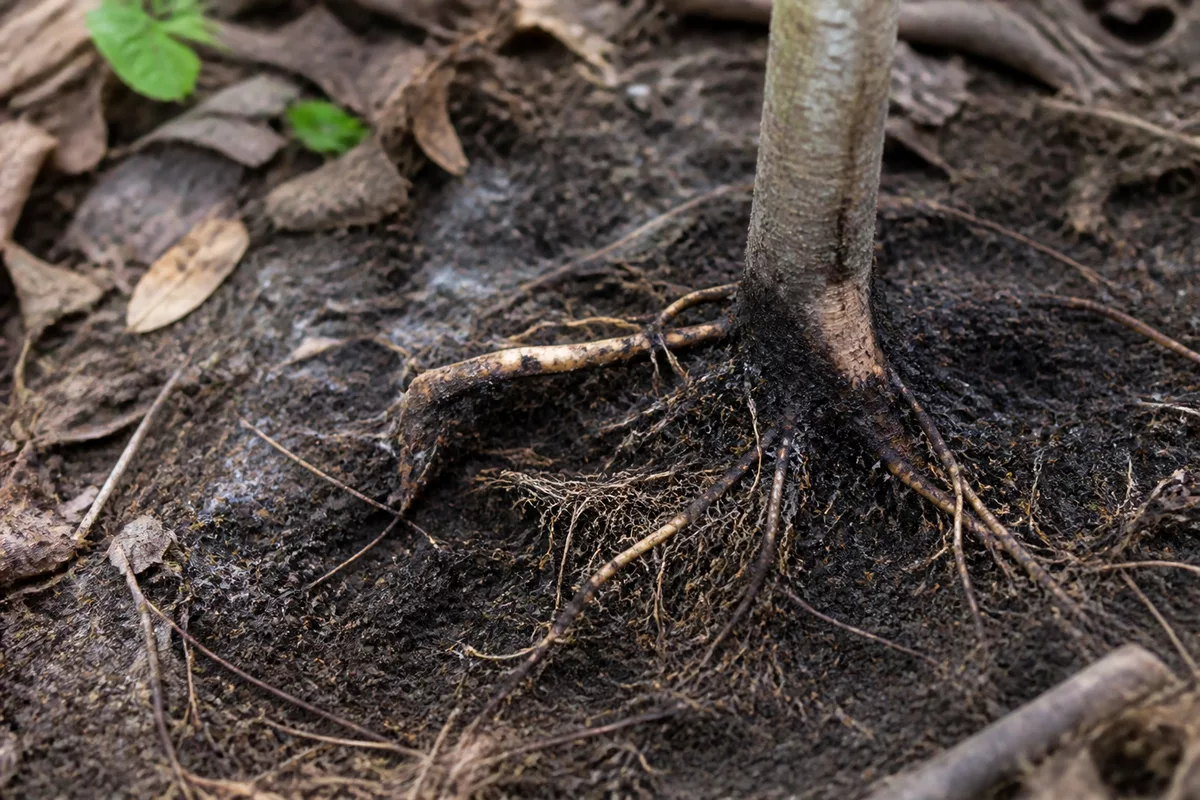
Yes. Many terrestrial plants live in association with microscopic soil fungi. The very fine filaments of these fungi, called hyphae, form a network called mycelium. When they colonize roots without destroying them, they create a mycorrhiza: an active exchange zone between two different organisms.
The visible part commonly called “mushroom” — porcini, amanita, chanterelle, or oyster mushroom — is usually just a reproductive organ producing spores. The true organism can be largely underground, dispersed in litter, dead wood, or around roots. The National Museum of Natural History also reminds us that fungi play a decisive role in recycling organic matter and the functioning of natural environments.
- The plant provides the fungus with carbon compounds derived from photosynthesis.
- The fungus explores a volume of soil inaccessible to the finest roots alone.
- It can contribute to the acquisition of water and mineral elements, especially when these are poorly mobile in the soil.
- The relationship varies: it can be beneficial to both partners, more neutral, or become less favorable depending on the context.
Soil networks are not a “plant internet” in the human sense: they are biological interfaces where resources, molecules, and interactions circulate.
Mycorrhiza, mycelium, and fruiting body: not to be confused
These three words refer to distinct realities. The mycelium is the network of fungal filaments; the mycorrhiza is the association between this fungus and a root; the fruiting body is the visible structure that produces spores. This distinction matters because a garden can harbor strong fungal activity without visible mushrooms appearing on the surface.
| Term | What it designates | Role in the soil | What is observed |
|---|---|---|---|
| Mycelium | Set of fungal filaments | Soil exploration, decomposition, local transport of resources | Often invisible to the naked eye |
| Mycorrhiza | Association between root and fungus | Exchange zone between the two partners | Visible mainly under a microscope or on certain roots |
| Fruiting body | Reproductive part of the fungus | Production and dissemination of spores | Fungus visible in forest, meadow, or garden |
How do mycorrhizas organize exchanges?
Mycorrhizas function like an enlarged exchange surface. The fungal hyphae extend into the soil micropores, where roots alone have difficulty accessing water or mineral elements. In return, the plant supplies the fungus with carbon derived from photosynthesis, in transformed forms usable by its partner.
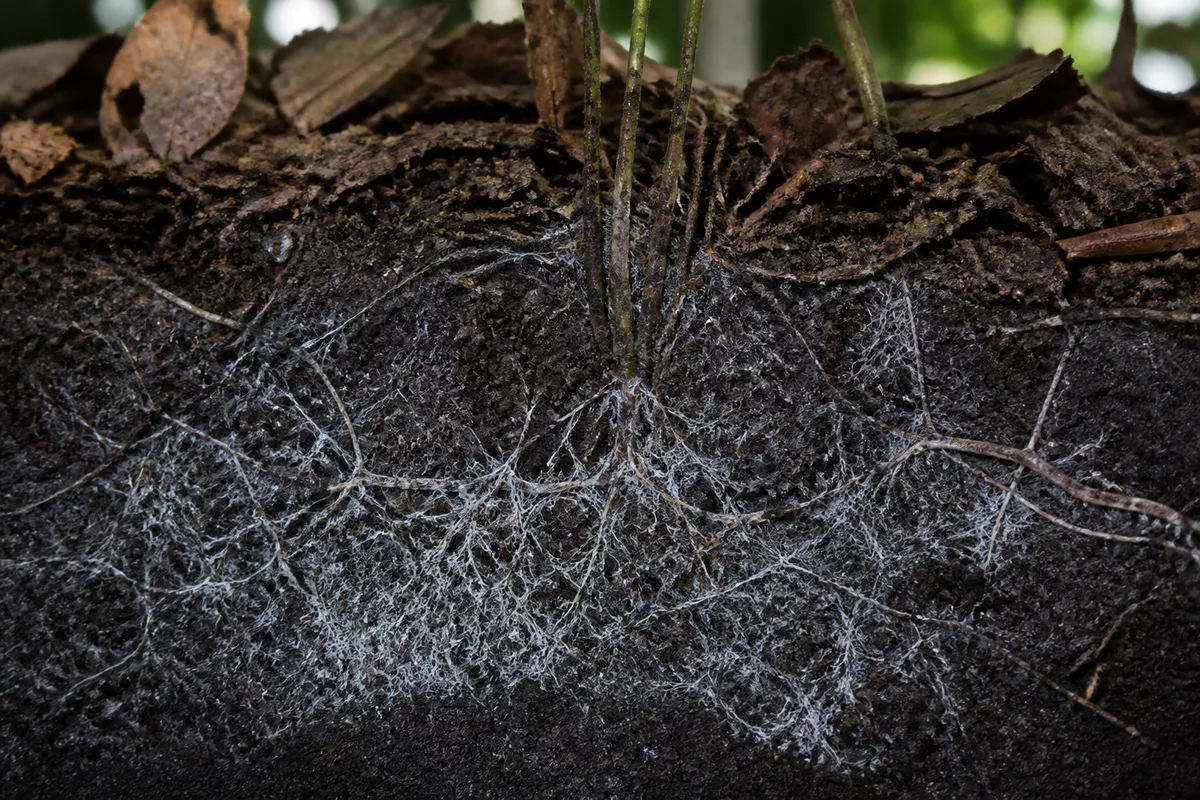
There are several forms of mycorrhizas. Arbuscular mycorrhizas are widespread among herbaceous plants, many crops, and some trees. Ectomycorrhizas, on the other hand, concern notably many forest species, such as certain pines, oaks, birches, or beeches. The structures formed and the partners are therefore not the same from one environment to another.
This cooperation is not a selfless gift. The fungus needs the carbon provided by the plant, while the plant can benefit from the fine soil exploration by the hyphae. The result, however, depends on the balance between the carbon cost for the plant and the actual gain in resources. In very fertile or heavily disturbed soil, the relative interest of certain associations may change.
- In poor soil: the extension of the fungal network can improve access to certain poorly available nutrients.
- During drought: the role of the fungal partner can be useful, but it varies greatly depending on the species and local conditions.
- In compacted or intensively worked soil: the filaments are more easily broken, which limits network continuity.
The links between plants and fungi are not limited to mycorrhizas. Some fungi decompose wood and dead leaves, others live as parasites, and others are associated with insects. The fungal world is therefore much broader than a single cooperation model.
Do fungal networks allow plants to send messages to each other?
In certain situations, a common mycorrhizal network can connect the roots of several plants. Scientific studies have shown that molecules, carbon, nitrogen, or stress-related signals can be transferred between connected plants. The phenomenon exists, but it does not justify the idea of a universal system where all plants constantly help each other.
Researchers use isotopic tracers, controlled cultures, and molecular analyses to track these movements. These methods are valuable because they avoid confusing transfer via the mycelium with direct movement in the soil, through air, or via roots. The delicate point is then to assess the ecological significance of these transfers in a real forest or meadow.
It is therefore necessary to distinguish three mechanisms often mixed up in popular accounts:
- Airborne signals: an attacked plant can emit volatile compounds perceived by other plants.
- Soil signals: roots release molecules that influence bacteria, fungi, and neighboring plants.
- Common mycorrhizal networks: the same fungus can establish connections with several root systems and participate in certain transfers.
To place this mechanism in a broader perspective, it is useful to discover the secret signals of the plant world, which also include molecules released into the air, defensive reactions, and chemical messages exchanged at the soil level.
A transfer detected between two plants does not, by itself, prove that one plant “voluntarily helps” another: the mechanism, context, and its real effect must be measured.
Why the expression “wood wide web” must be used with caution
The expression “wood wide web,” often translated as “forest internet,” has the merit of making visible an underground world long ignored. It can also mislead the reader. A computer network is designed to transmit data according to stable technical rules; a fungal network is living, changing, local, and subject to competition between organisms.
Fungi are not simple cables. They use resources, grow, respond to soil conditions, and interact with a multitude of other species. Plants, for their part, do not constitute a homogeneous group: they can be of the same species, belong to different species, compete for light, or share the same network without deriving the same benefit.
What do we really know about plant communication through fungi?
Research clearly supports the existence of mycorrhizal associations and substance exchanges between partners. It also documents, in certain setups, transfers between plants connected by a common fungus. However, the importance of these exchanges in all ecosystems, their direction, and their effect on plant survival remain debated questions.
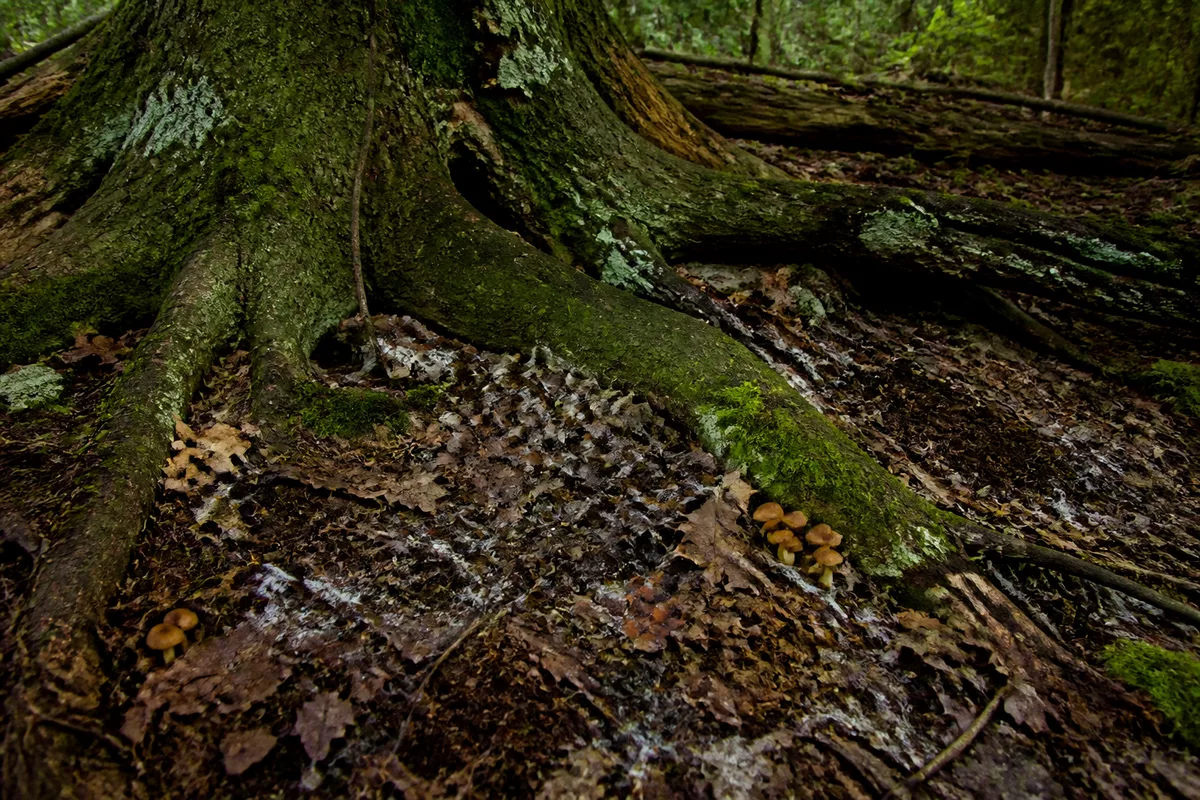
A result observed in a greenhouse or pot does not mechanically translate to an old forest. In natural environments, roots are connected to many fungi, the soil contains very diverse microbial communities, and resources circulate through several pathways simultaneously. The proper scientific interpretation is to recognize the role of fungal networks without attributing all observed exchanges in the soil to them.
| Statement | What can be retained | Caution |
|---|---|---|
| Fungi help plants to feed | Often true in a functional mycorrhizal association | The effect depends on species, soil, and resource availability |
| A fungus can connect several plants | Possible when a common mycorrhizal network is established | Connection does not guarantee significant or beneficial transfer |
| Trees always feed young plants | Transfers have been measured in some contexts | This is not a general rule applicable to all forests |
| Plants warn each other of danger via fungi | Stress-related signals have been experimentally studied | Mechanisms and ecological consequences must be examined case by case |
This caution does not detract from the fascination of the subject. It makes it more robust. Understanding plant communication means accepting that living relationships are made of cooperation, competition, recycling, and opportunism, sometimes simultaneously.
How to promote useful fungi in a garden?
The best reflex is less to “add fungi” than to preserve the conditions that allow soil life to be maintained. A covered, lightly compacted soil rich in diverse organic matter generally offers a more favorable habitat for roots, fungi, and other organisms that contribute to its fertility.
Avoid considering every visible mushroom as a problem. A cap appearing in a lawn or at the base of a shrub often signals decomposition activity or the presence of moist organic matter. The systematic removal of fruiting bodies does not necessarily eliminate the mycelium already present in the soil.
- Maintain ground cover: dead leaves, chipped branches, plant mulch, or suitable ground cover plants.
- Limit deep and repeated digging, which disrupts tunnels, fine roots, and fungal filaments.
- Diversify plants to multiply habitats and possible underground relationships.
- Avoid excessive applications of highly soluble fertilizers, especially when they do not meet any identified needs of the soil or crops.
- Leave some dead wood, when compatible with site safety, as it feeds many decomposer fungi.
Products presented as “mycorrhizal inoculants” deserve careful reading. Their effectiveness can depend on the plant, fungal species, substrate, presence of already established fungi, and cultural practices. A product is therefore not an automatic shortcut to living soil: sustainable improvement first passes through the habitat offered to living organisms.
And mushrooms used for food or supplements?
Mushrooms studied for their food uses or as supplements should not be confused with garden mycorrhizal fungi. Some species, such as shiitake, reishi, or maitake, are of growing interest, but health claims must be examined methodically. To understand what research really changes, it is better to distinguish preliminary results, traditional uses, and solid clinical evidence.
The quality of the product, the part of the mushroom used, the declared concentration, and possible interactions with treatments matter more than an appealing slogan. People undergoing medical treatment, pregnant, breastfeeding, or affected by chronic illness should seek advice from a health professional before consuming a dietary supplement.
Why are soil networks important for forests and crops?
The networks formed by fungi are not only useful to individual plants. They participate in the overall functioning of soils: decomposition of plant residues, structuring of certain soil aggregates, local nutrient circulation, and interaction with bacteria, insects, and roots. Their presence is therefore linked to the ecological health of an environment, without being the only indicator to consider.
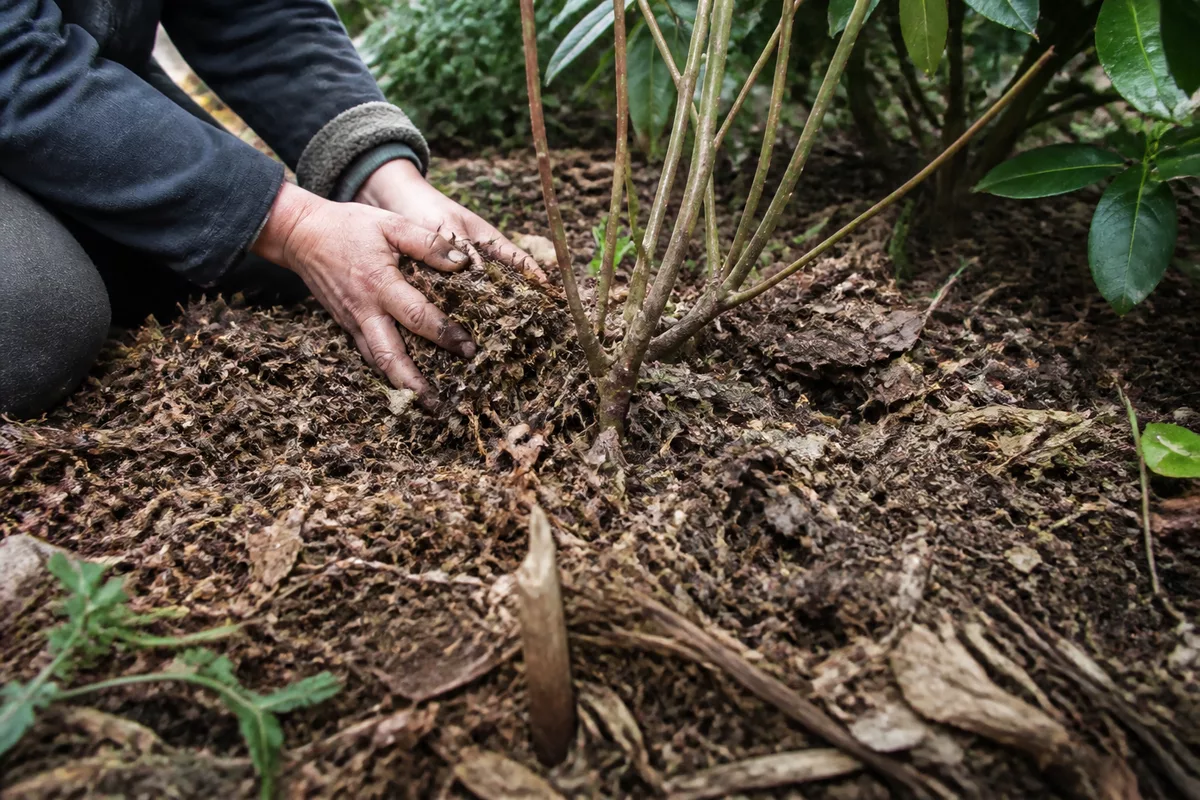
In forests, ectomycorrhizal fungi accompany many trees and participate in carbon and nutrient cycles. In crops, arbuscular mycorrhizae may interest farmers, especially in systems seeking to limit soil disturbances. Preserving soil biodiversity means protecting a set of interactions, not a single miracle species.
Fungi are also essential recyclers. Without them and other decomposers, dead leaves, wood, and organic matter would accumulate much more. This function is sometimes less spectacular than a porcini mushroom in the moss, but it supports the entire living chain.
Useful sources to consult
The subject evolves with the pace of research in soil ecology. To verify a statement or deepen a specific mechanism, prioritize scientific publications and specialized institutions rather than overly simplified accounts.
- National Museum of Natural History: reliable references on the diversity of fungi, their biology, and their ecological roles.
- INRAE: resources on soils, plant-microorganism interactions, and agricultural systems.
- National Institute for Agricultural, Food and Environmental Research: reference works on soil dynamics and agroecological practices.
- Scientific publications in plant and fungal ecology: useful for distinguishing controlled experiments from results observed in natural environments.
Frequently Asked Questions about Fungi and Plants
Can fungi live without plants?
Yes, many fungi live without mycorrhizal association. Decomposer fungi, for example, feed on dead organic matter such as wood, leaves, or certain plant residues. Others are parasites or associated with animals.
Do all plants have mycorrhizae?
No. Many plants form mycorrhizal associations, but not all, and the types of mycorrhizae differ according to plant families. Some plants can also reduce this association when soil conditions do not make it advantageous.
Is a visible fungus in the garden necessarily beneficial?
Its presence often indicates that organic matter is being broken down, but it alone does not allow one to conclude whether it is beneficial or harmful. Some fungi live on dead wood, while others may be linked to plant diseases. Identification and the condition of the plant matter more than the appearance of a cap.
Do plants really exchange nutrients through mycorrhizae?
Transfers have been measured in some studies, notably with tracers that track carbon or nitrogen. However, their real importance depends on the context: species present, resource availability, type of fungus, and soil conditions. It would therefore be unwise to make this a systematic rule.
Should one buy a mycorrhizal product to improve their vegetable garden?
Not necessarily. Before considering an inoculant, it is often more useful to work on soil structure, maintain plant cover, and limit unnecessary disturbances. A product may be useful in some cases, but its effectiveness is never guaranteed without taking into account the plant and soil involved.
(function(){
var ov=document.getElementById(‘magic-lb’);if(!ov)return;
var img=ov.querySelector(‘img’),btn=ov.querySelector(‘.magic-lb-close’);
function open(src){img.src=src;ov.classList.add(‘open’);document.body.style.overflow=’hidden’}
function close(){ov.classList.remove(‘open’);img.src=”;document.body.style.overflow=”}
document.addEventListener(‘click’,function(e){
var a=e.target.closest(‘a.magic-img-link’);
if(a){e.preventDefault();open(a.getAttribute(‘href’));return}
var i=e.target.closest(‘.wp-block-image img’);
if(i&&!e.target.closest(‘a’)){e.preventDefault();open(i.currentSrc||i.src)}
});
ov.addEventListener(‘click’,function(e){if(e.target===ov||e.target===btn)close()});
document.addEventListener(‘keydown’,function(e){if(e.key===’Escape’)close()});
})();
