

Sommaire
Quality Mushroom Extract: The Criteria That Really Matter
A quality mushroom extract is not judged by a well-packaged slogan, but by some very concrete proofs: the part of the mushroom used, the extraction method, standardization, and control analyses. In other words, it’s not storytelling that decides, it’s transparency.
The market often mixes products that have little to do with each other under the same wellness promise. Some display flattering figures, others play the “natural” card without providing enough useful information. That’s why you need to learn to read the label like a small audit, not like an advertising poster.
In this logic, the goal is simple: know what to check before buying, which clues inspire confidence, and which details should raise an eyebrow. The reader then gains a sorting method, more useful than a succession of interchangeable marketing arguments.
In Brief
🔎 A good extract is first recognized by a clear composition and readable traceability.
🧪 The extraction method counts almost as much as the chosen species, especially for beta-glucans and certain specific compounds.
📄 Laboratory analyses and the batch number are worth more than a vague promise of “purity.”
⚠️ The word organic reassures, but it does not replace formula transparency or contaminant control.
How to Recognize a Quality Mushroom Extract?
A quality mushroom extract is read like a technical document, not like a vague promise. It clearly indicates the part of the mushroom used, the extraction method, the standardized compounds, and the controls performed. If the label remains vague, the risk is simple: buying talk instead of buying a verifiable product.
The first rule is to distinguish what is measurable from what is only suggestive. A mention like “ultra concentrated” says nothing by itself, whereas an identified batch, a specified extraction method, and a certificate of analysis already make the product much more serious. This is where the real difference lies between a serious product and flashy packaging.
The most solid quality pages do not stop at a selling keyword. They explain the raw material, detail the process, announce the key parameters, and provide control elements. For a broader reading of mushroom-based formulas, you can also consult this guide on truly quality formulas, which complements this reading framework well.
Packaging reassures; a certificate of analysis convinces. Between the two lies the entire gap between marketing and proof.
Why Aren’t All Extracts Equal?
Because an extract is not just a “concentrated version” of a mushroom. What is concentrated is also an origin, a part of the fungal plant, a process, and sometimes ambiguities. Two products can display a similar name while relying on very different raw materials, with a technical value incomparably less homogeneous.
The key point is that the word “extract” only makes sense if you know what it is extracted from. A product derived from the fruiting body does not have the same logic as a product based on mycelium or a hybrid formula. In the first case, the visible part of the mushroom is targeted; in the second, it is a vegetative network that can be cultivated differently and whose composition deserves to be explained.

The most useful comparisons are therefore not made between “natural” and “chemical,” but between clear formula and opaque formula. The reishi market clearly illustrates this problem: the INH cites a USP/Nature study on 19 products sold as Reishi, of which only 5 were compliant. Such a discrepancy reminds us that a mushroom name alone guarantees nothing.
Does the part of the mushroom used really change the quality?
Yes, and it is even one of the first criteria to check. The fruiting body is often highlighted when seeking a more direct reading of the raw material, while the mycelium can be relevant if the cultivation method and composition are clearly detailed. The problem is not the mycelium itself, but the lack of precision.
- Fruiting body: generally more explicit for the consumer, as it corresponds to the harvested part of the mushroom.
- Mycelium: acceptable if the product specifies the cultivation substrate, the actual extracted portion, and the controls performed.
- Vague mixture: to be watched, especially if the label mentions “mushroom” without details on the part used.
For the reader, the right reflex is simple: if the label does not specify the part of the mushroom, it should be considered missing information, not a trivial detail. This is where the powder or extract comparison becomes useful, because it clearly shows that the form does not say everything, and that quality depends on the real structure of the product.
What type of extraction should be favored?
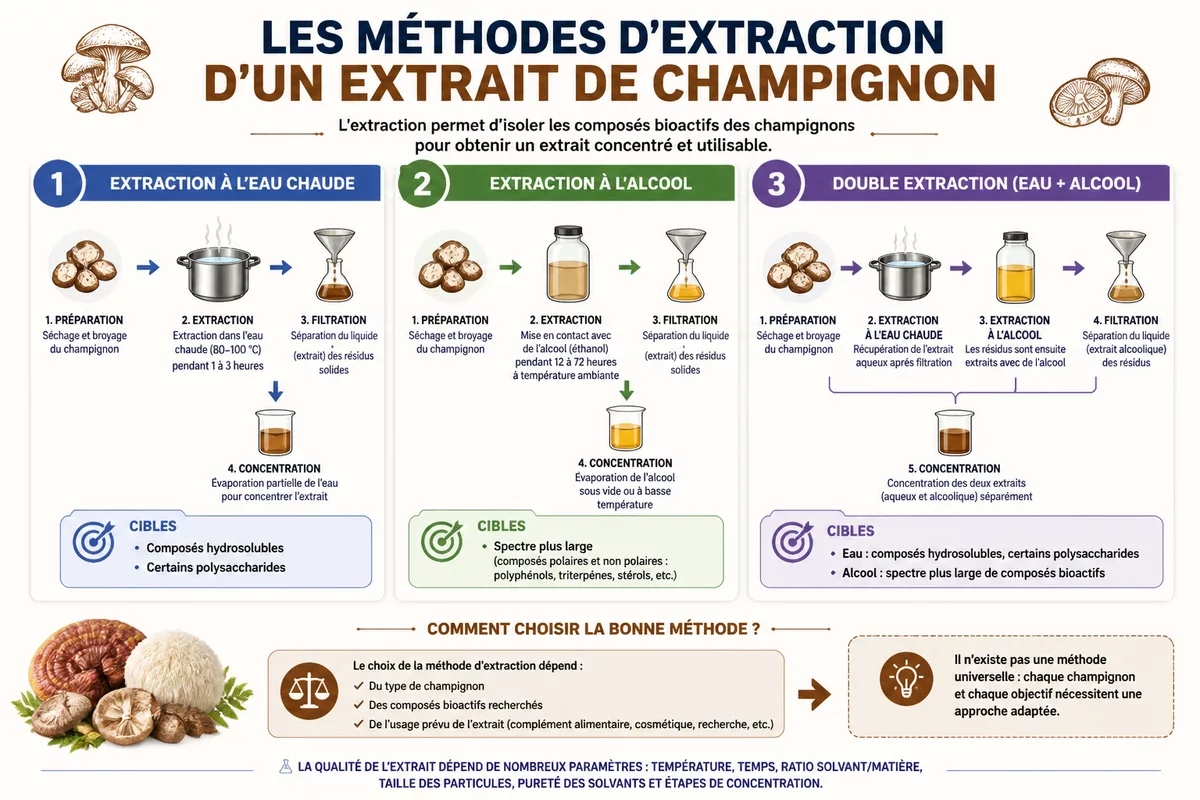
The best extraction method is the one that corresponds to the mushroom, the compounds sought, and the manufacturer’s transparency. In practice, water extraction mainly recovers water-soluble compounds such as certain polysaccharides, while hydroalcoholic extraction covers a broader spectrum. Double extraction combines both approaches.
This point is crucial, because a poorly explained extraction can be either very effective or very incomplete, without the buyer being able to know. For a reishi or a chaga, for example, a well-thought formulation can highlight a logic of double extraction. For other species, the interest of a more complex process must be demonstrated, not just proclaimed.

It is also important to keep a simple idea in mind: the more a manufacturer details their process, the easier it becomes to assess the coherence between the raw material and the result. Conversely, a mention like “exclusive extract” without method or solvent is an orange flag. Moreover, a complementary article on adaptogenic mushroom synergies helps understand why the galenic form can change the actual use of a product.
Are beta-glucans and polysaccharides enough to judge a product?
Not by themselves. Polysaccharides are a broad family, and the term can encompass very different compounds. Beta-glucans are often more informative, as they refer to a specific category of polysaccharides frequently highlighted in mushroom extracts. But an isolated percentage never replaces a complete reading of the product.
In practice, several market extracts announce a standardization at 30% polysaccharides. The figure can be useful, but it is not sufficient on its own. It does not say which part of the mushroom was used, nor which process was used to achieve this result, nor if the product was tested for contaminants. In short, it is a piece of the puzzle, not the whole puzzle.
A percentage is reassuring mainly when accompanied by context. Without the part of the mushroom, the method, and the batch, it remains easy to display and difficult to interpret.
| Criterion | What to read | Trust signal | Warning signal |
|---|---|---|---|
| Part used | Fruiting body or mycelium | Explicit and coherent mention | “Mushroom” without specification |
| Extraction | Water, alcohol, or double extraction | Detailed method | Vague formulation or “patented secret” |
| Standardization | % of beta-glucans or polysaccharides | Contextualized figure | An isolated ratio presented as absolute proof |
| Controls | Heavy metals, pesticides, microbiology | Batch analysis or certificate | “Tested” without document |
| Traceability | Origin, batch, manufacturer | Complete information | Origin absent |
Are quality controls really decisive?
Yes, because a mushroom is a living material that can absorb its environment. That is precisely why issues of heavy metals, pesticides, and microbiology are not minor details. A serious product must therefore be able to show, at a minimum, that it has been tested on these points by laboratory analyses.
Useful institutional benchmarks are not lacking: for contaminants, the pages of the EFSA are a good basis for understanding, while the ANSES regularly recalls the importance of contaminants in food and supplements. If the question concerns the regulatory framework of dietary supplements, Service-Public and Légifrance remain the most reliable references to check the rules in force.

A common mistake is to believe that an “organic” product is automatically free of any concern. In reality, organic can reduce certain risks, but it does not replace either a well-explained extraction or an analytical control by batch.
The organic label therefore has value, but it does not close the investigation. It reassures on part of the agricultural risk, not on the entire industrial process. That is precisely why an organic mushroom extract must be evaluated as a whole: origin, process, batch, analyses, and overall coherence. The rest is mostly decoration.
How to read a label without being fooled?
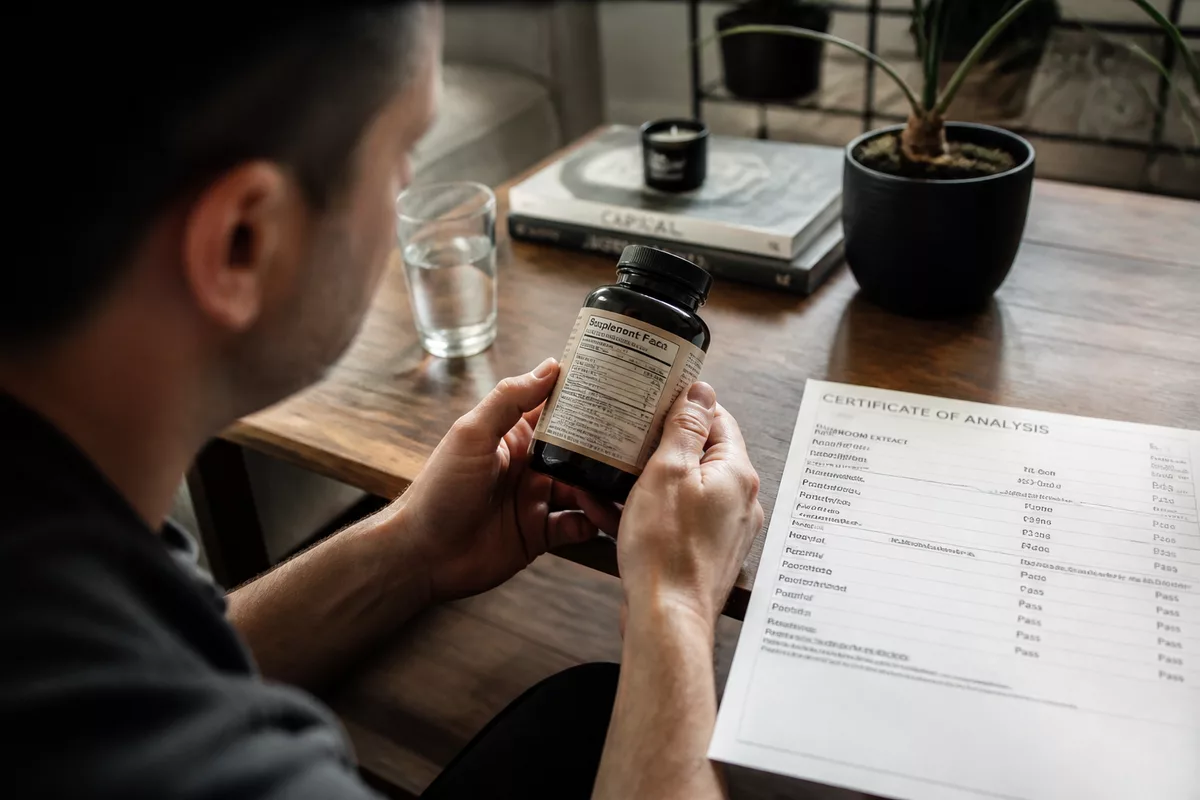
The right method is to read the label in the same order as you would read a technical file: first the raw material, then the process, then the numerical indicators, and finally the controls. In less than a minute, this logic already allows you to separate a serious product from an opportunistic one.
- Check the part used: fruiting body, mycelium, or clearly described mixture.
- Identify the extraction: water, hydroalcoholic, or double extraction.
- Review the figures: standardization, ratio, daily dose, number of capsules.
- Look for a batch: certificate of analysis, origin, manufacturer, date if available.
- Discard vague promises: “power,” “ultimate purity,” “guaranteed result.”
Ultimately, the most useful thing is not to confuse the quantity of arguments with the quality of information. A product that multiplies adjectives without providing verifiable data is often less reliable than a sober product that clearly displays its parameters. To deepen the perspective on product range reading, you can also compare with this guide on vitamin D3 or D2, very useful on how to choose a form rather than a slogan.
Extract, powder, mycelium: what should you choose depending on the case?
There is no “magically superior” form in absolute terms. The right choice mainly depends on what the product actually displays and what is expected from the formula. A concentrated extract will be interesting if you are looking for a clear reading of the standardization; a powder may suit a simpler approach; mycelium can be relevant if traceability is impeccable.
The important point is to distinguish concentration and quality. A high ratio is not a guarantee, as it can mask a non-transparent method or an average raw material. Conversely, a less “spectacular” formula can be better constructed if it precisely details the origin and control of the components.
If you hesitate between several formats, the most reasonable approach is to compare the readability of the formula, then the consistency between the promise and the process. For cases where the form really influences the choice, content like chaga powder or extract can serve as a reference, as it clearly shows that the format should follow the use, not the other way around.
The most common marketing traps around mushroom extracts
The first trap is to give a single figure the status of total proof. The second, more subtle, is to use technical words without explaining them. The third, finally, is to overlap wellness vocabulary and product quality vocabulary, as if one automatically validated the other. In reality, these are three different things.
Here are the most frequent warning signs:
- A powerful claim without method or analysis to back it up.
- A percentage cited without specifying the raw material.
- A vague origin or missing on the batch.
- Scientific terms used as marketing decoration.
- A health promise that serves to mask the lack of product information.
When the product sheet speaks louder than the label, the consumer often pays more for the staging than for the composition.
In short, the right question is not “does this product promise a lot?”, but “does this product give me enough information to verify its consistency?”. This is where the difference between an informed purchase and a blind purchase lies. And if you want a more complete reading of the wellness mushroom universe, the article on truly quality formulas goes in the same direction, with a complementary approach.
Key takeaways
🔸 A good extract is proven by transparency, not by a flattering slogan.
🧾 The part of the mushroom, the extraction method, and the batch must be readable.
🧪 Laboratory analyses on contaminants really change the product reading.
⚖️ Beta-glucans and polysaccharides help compare but are not sufficient alone.
🌿 Organic remains a plus, never an absolute proof of quality.
FAQ
Is an organic extract necessarily better?
No, not automatically. The organic label can reduce certain risks related to cultivation, but by itself, it says nothing about the clarity of the extraction, standardization, or the quality of the controls. A good organic product remains a product that is well explained.
Is mycelium alone enough to judge quality?
No, because the word mycelium alone is not enough. You need to know how it is cultivated, on what substrate, what portion is actually extracted, and what controls have been carried out. Without these details, you do not assess quality; you guess.
Are beta-glucans the only important criterion?
No, even though they are very useful. They help appreciate standardization, but they do not replace origin, the part of the mushroom, or contaminant analyses. A well-displayed percentage does not erase an incomplete product dossier.
Can you recognize a good product by its color or taste?
Not reliably. Color or aroma can vary depending on the species, extraction method, and formula, but they never replace objective data. To choose confidently, it is better to have a certificate of analysis than a sensory impression.
What is the value of an extraction ratio without further details?
Not much if the rest is missing. A ratio can be useful, but only if it is accompanied by the part of the mushroom, the process used, and indications of standardization. Without context, this figure looks more like a marketing argument than a technical proof.
