

Sommaire
Mushrooms, diet and hydration: the right reflexes to support physical effort
Effort hydration often starts even before the first step: an ordinary session can become laborious simply because one has drunk too little, eaten poorly, or chosen a meal that is hard to digest. Conversely, a simple, realistic, and regular strategy improves comfort, effort tolerance, and recovery. In this context, sports nutrition is not limited to powders and sugary drinks: some everyday foods, including mushrooms, also have a real place on a useful plate, especially if one seeks a balance between performance, digestion, and mushrooms and well-being.
Why does effort hydration really change performance?
Well-managed effort hydration helps maintain body temperature, blood volume, and the ability to produce steady effort. As soon as we sweat more, heart rate rises faster, fatigue sets in earlier, and recovery becomes less effective.
Water is not only used to “avoid thirst.” It participates in thermoregulation, nutrient transport, elimination of some metabolic waste, and maintenance of plasma volume. When this volume decreases, the heart must compensate more to supply the muscles. Result: the effort feels harder at the same intensity, especially in running, cycling, team sports, or indoor sports when the air is hot and dry.

According to ANSES guidelines, water remains the reference drink daily, and it is also the basis of any sports-related strategy. In practice, many amateur athletes underestimate their sweating, especially during a one-hour “not so intense” indoor training, in summer, or with technical clothing that is not very breathable. The sensation of thirst is useful, but it often arrives after the start of the hydration deficit.
A simple indicator remains the trio unusual thirst, dry mouth, and decreased clarity, sometimes accompanied by dark urine, headaches, or a sensation of heavy legs as soon as warm-up. A simple glass of water clearly visible on the work surface, or better yet a graduated bottle, already helps to objectify habits and move away from “I drink when I think about it.”

- Before effort: abnormally early fatigue, dry mouth, dark urine upon waking.
- During effort: more marked breathlessness, rapid increase in heart rate, decreased concentration.
- After effort: headaches, feeling of “battery drained,” slow recovery.
How to adjust hydration before, during, and after exercise?
The most reliable guideline remains simple: drink regularly before training, split intake during exercise, then compensate for losses after the session. For most adults, aiming for small repeated amounts is more effective and better tolerated than large volumes consumed at once.
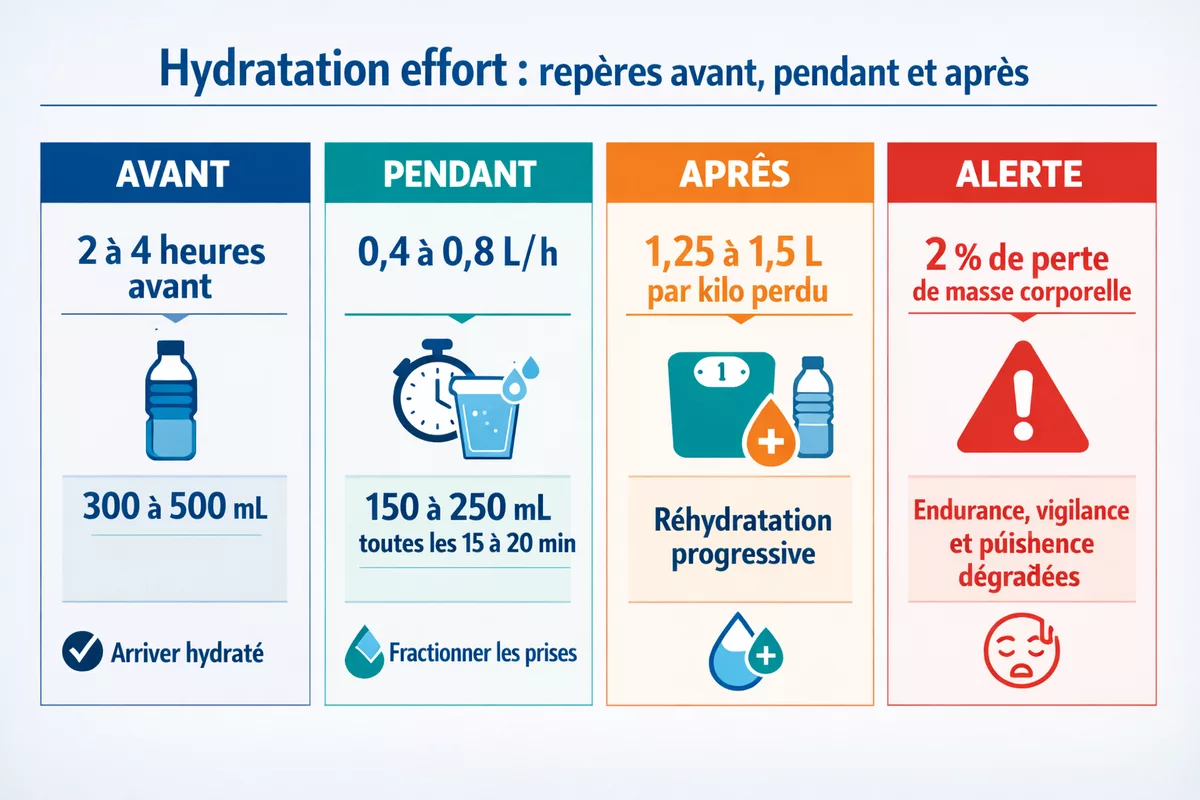
Before a session, the goal is not to “chug” water but to arrive already hydrated. In the 2 to 4 hours preceding, an intake of about 300 to 500 mL is often suitable for a standard workout, to be adjusted according to body size, weather, and the last meal. Just before starting, a few sips are usually enough. During exercise, the guidelines used in sports nutrition most often range around 0.4 to 0.8 L per hour, which in practice means 150 to 250 mL every 15 to 20 minutes, with large variations depending on heat and sweating.
| Situation | Recommended drink | Indicative quantity | Point of caution |
|---|---|---|---|
| Effort < 1 h, moderate intensity | Water | A few sips before, then according to thirst | Do not start already dehydrated |
| Effort from 1 to 1 h 30 | Water, or lightly mineralized drink | 150 to 250 mL every 15-20 min | Test digestive tolerance |
| Endurance > 1 h 30 | Drink with sodium and carbohydrates | 0.4 to 0.8 L/h depending on sweat | Avoid overly concentrated drinks |
| High heat | Water + electrolytes depending on sweating | More frequent intakes | Watch for signs of heat stroke |
| After exercise | Water + salty meal and carbohydrates | Progressive rehydration | Do not forget sodium losses |
After training, recovery does not depend solely on the water drunk within the hour. It is also necessary to replenish sodium losses, restore carbohydrate stores if the session was long, and include a protein source if the goal includes muscle repair and adaptation to training. To learn more about practical guidelines before, during, and after the session, you can see the details.
Drinking only when thirst becomes obvious is often reacting too late to maintain a stable intensity and a controlled effort sensation.
A very practical way to personalize your needs is to weigh yourself before and after a typical session, without wet clothes and under comparable conditions. A loss of 600 g roughly corresponds to 600 mL of water lost, excluding drinks consumed during training. This test does not replace medical monitoring, but it provides a much more useful estimate than a generic copy-pasted advice.
What to drink depending on duration, intensity, and heat?
For short and moderate effort, water is usually sufficient. When the session extends beyond 60 to 90 minutes, when it is hot, or when sweating is significant, a drink providing sodium and some carbohydrates often becomes more relevant than water alone.
The right drink depends less on marketing than on the actual context. For a gentle 45-minute jog, a typical strength training session, or a mobility class, water alone is generally sufficient. However, for trail running, a long bike ride, a match, or training in high heat, sweating accelerates and sodium losses become more significant. In this case, a well-dosed sports drink can help maintain hydration and energy intake, provided it remains tolerable for digestion.
The Ministry of Sports regularly reminds us, during heat waves, that intensity, duration, and environment completely change the situation. Indoors, we often forget that poorly ventilated air also increases needs. An ice-cold drink is not necessarily ideal if it suppresses the desire to drink or causes gastric discomfort. The same logic applies to very sugary drinks: they may seem “energizing,” but sometimes slow gastric emptying when too concentrated.
- Water alone: suitable for most short, moderate, and well-prepared efforts.
- Water + electrolytes: useful in hot environments, for heavy sweaters, or during repeated efforts.
- Sports drink with carbohydrates: especially relevant when the session lasts long, when intensity is sustained, or when prior nutrition was insufficient.
- Very sugary or alcoholic drinks: poor choices around exercise, for obvious reasons of tolerance and effectiveness.
Mushrooms and recovery: what they really provide
It is observed in the field that athletes who poorly tolerate very fatty meals before an outing often digest better a simple plate with rice, eggs or tofu, and sautéed mushrooms. It’s not magic: it’s mainly lighter, more consistent, and easier to reproduce from one session to another.
Mushrooms have a simple but often forgotten advantage: they easily fit into a realistic sports nutrition strategy. Common varieties like the button mushroom, shiitake, or oyster mushroom are low in calories, rich in water, and interesting for diversifying micronutrient intake. According to the ANSES Ciqual table, their water content often ranges around 85 to 92% depending on species and preparation, which obviously does not replace drinking, but contributes to overall dietary hydration.

Shiitakes, for example, are often appreciated for their texture and aromatic density, which allows enriching a recovery meal without unnecessarily weighing it down with fats. On the plate, they fit well with a source of digestible carbohydrates and a source of proteins, rather than being consumed alone as if they were a miracle solution.

It is important to remain precise: mushrooms do not replace carbohydrates useful for endurance, nor proteins useful for muscle recovery. Their interest lies elsewhere: food volume, moderate satiety, richness in flavor, micronutritional diversity. For someone looking to eat better around sports without falling into ultra-processed products, that is already a lot. If the subject interests you, the analysis of mushroom coffee also helps to distinguish the fad effect from truly useful uses.
Regarding supplements, caution is also advised. Powders, extracts, or “adaptogenic” blends do not all have the same level of evidence nor the same interest depending on your goal. It is better to understand which form of chaga to choose before buying a product presented as indispensable. And if you pick mushrooms yourself, the rule is non-negotiable: never improvise, because recognizing a toxic mushroom is a matter of safety, not folklore.
Composing a useful plate before and after exercise
Before training, the best meal is not the most “healthy” on paper, but the one that provides energy without hindering digestion. Mushrooms can perfectly fit into this framework if they are simply cooked, in reasonable quantity, and accompanied by a more energy-rich base. A huge stir-fry, very spicy or drowned in cream just before an intense session, on the other hand, can quickly become a bad idea.
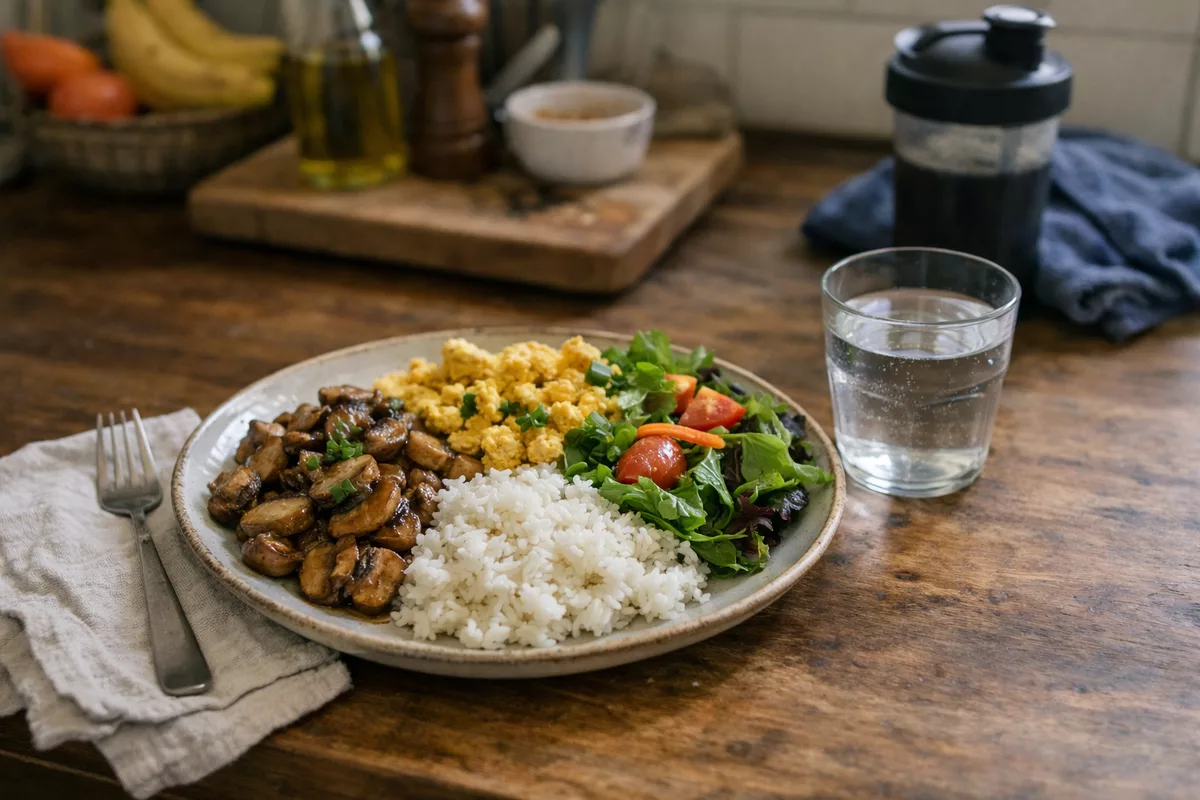
- Before exercise: rice, pasta or bread + eggs, tofu or poultry + a small portion of cooked mushrooms.
- After exercise: potatoes, quinoa or semolina + protein source + sautéed mushrooms + a bit of salt.
- As a snack far from the session: mushroom soup + savory toast, especially interesting in cold periods.
- To avoid just before intense effort: very fatty, very fibrous meals or those tested for the first time on the day.
Overall, a recovery plate works better when it brings together three things: water, carbohydrates, and a protein source. Mushrooms then complement the picture, not replace it. This is exactly the nuance often missing in promises around “superfoods.” To follow market developments without overinterpreting science, you can also read functional mushroom trends.
Common mistakes that sabotage physical effort
Most failures do not come from a lack of discipline, but from a poor hierarchy of priorities. Sometimes we think about the “technical” drink before thinking about the water drunk during the day, or the mushroom-based supplement before checking if the plate contains enough carbohydrates and proteins. Joking aside, this is often where it gets stuck.
- Waiting until very thirsty: you end up catching up instead of staying stable.
- Drinking a lot at once: digestive discomfort, bloating, desire to stop drinking afterwards.
- Copying another athlete’s needs: weight, weather, sweating, and intensity change everything.
- Confusing a light meal with an insufficient meal: if reserves are low, water will not compensate for the lack of energy.
- Imagining that mushrooms alone are enough to “boost” effort: they support dietary balance, not performance by themselves.
An amateur athlete family often tells the same story after a few weeks of adjustment: the most visible gain does not come from a spectacular product, but from a finally consistent routine. Drinking earlier, salting meals a little better after long sessions, keeping a water bottle accessible, and incorporating simple foods like mushrooms into repeatable meals. It’s basic, but that’s precisely what works best in the long run.
A simple routine to connect hydration, nutrition, and recovery
If you are looking for an easy framework to maintain, the idea is not to measure everything down to the milliliter. Often, a stable protocol is enough, then refined according to how you feel and the conditions. Here is a solid base for the majority of regular recreational practitioners.
- 2 to 4 hours before: drink 300 to 500 mL, then plan a digestible meal with carbohydrates + proteins + cooked vegetables if needed.
- 15 minutes before: just a few sips, especially if the last glass was a while ago.
- During: drink small regular sips, more if it is hot or if the session exceeds 1 hour.
- Within the hour after: water, salty meal, carbohydrates and proteins; mushrooms can enrich the dish without making it heavy.
Key takeaways
💧 Effort hydration is prepared before the session, not just during.
🍄 Mushrooms support varied sports nutrition but do not replace carbohydrates or proteins.
🌡️ Heat, duration, and sweating strongly modify drink needs.
🥤 For short and moderate effort, water is often enough; beyond that, electrolytes and carbohydrates can become useful.
🧠 The best strategy remains the one you can repeat without digestive discomfort.
FAQ
Can you eat mushrooms just before training?
Yes, but preferably cooked and in moderate portions, integrated into a simple meal. Just before intense effort, it is better to avoid very fatty, very spicy, or very bulky preparations, as digestion may detract from comfort during the session.
How do I know if I sweat “a lot” and if I need to drink more?
The most concrete way is to weigh yourself before and after a typical session. If you lose 700 g despite a few sips during the effort, your actual losses already exceed this volume, indicating that a more structured plan would be useful.
Is sparkling water suitable after sport?
It can be suitable if you tolerate it well, especially away from the effort. However, just after an intense session, some people feel more bloating; still water often remains easier to drink in progressive amounts.

Are mushrooms interesting for bodybuilding?
Yes, especially to enrich the plate without weighing it down. They do not provide enough protein to replace a real protein source, but they integrate well into a recovery meal with rice, potatoes, eggs, fish, tofu, or lean meat.
Should you drink even if the effort lasts less than 45 minutes?
Most often, starting well hydrated is enough, especially if the temperature is moderate. But in the middle of summer, in a poorly ventilated room, or for people who sweat a lot, a few sips during or just after remain quite relevant.
