

Sommaire
Melatonin and sleep: real effectiveness, proper dosage, and useful precautions
Melatonin and sleep are linked by a simple mechanism: melatonin mainly helps send the signal of night to the brain, which can facilitate falling asleep when the internal clock is off. It does not act like a traditional sleeping pill, and its usefulness depends greatly on the context of use.
The key point is therefore to distinguish occasional help, reasonable dosage, and situations where melatonin intake should remain secondary. This guide explains what is known about melatonin’s effectiveness, the timing of intake, melatonin precautions, and cases where medical advice is necessary.
In brief
🌙 Melatonin can mainly help with falling asleep and jet lag, not for all sleep disorders.
💊 The clearest official guideline for falling asleep is 1 mg before bedtime, according to EFSA, but the product form matters as much as the dose.
⚠️ Interactions and risk situations must be checked before any self-medication, especially in case of ongoing treatment, pregnancy, or chronic health problems.
Understanding melatonin and its role in sleep
Melatonin is a hormone produced by the pineal gland that helps synchronize the day-night cycle. Inserm reminds us that evening light inhibits this signal, which explains why screens and overly bright lighting often delay falling asleep.
In simple use, melatonin mainly serves to signal that the rest phase is approaching. It does not induce sleep abruptly, and its effect depends on the timing of intake, lifestyle rhythm, and the real cause of the sleep disorder.
Natural melatonin, supplement, and medication
Natural melatonin corresponds to the body’s production; melatonin supplements provide an external amount; melatonin-based medication falls under a stricter framework. This distinction matters because tolerance, indication, and monitoring are not the same.
- Natural production mainly follows light and life schedules.
- The supplement aims for a punctual effect on falling asleep or jet lag.
- The medication is used according to an indication and dosage defined by a healthcare professional.
Why evening light changes everything
A very bright evening delays melatonin secretion and shifts the internal clock. For those who want to act without adding any product, managing light often remains the first useful measure, especially in case of repeated late bedtimes.
Is melatonin really effective for sleeping?
The answer is yes, but in a targeted way: melatonin can help reduce the time to fall asleep, especially when the problem comes from a disturbed rhythm. EFSA recognizes that 1 mg before bedtime contributes to this goal, but this effect remains modest if insomnia has another cause.

Melatonin is not a universal shortcut to sleep; it is mainly useful when the night signal arrives too late.
The right reflex is to seek a measurable benefit on falling asleep, not a promise of immediate deep sleep. This nuance prevents concluding too quickly that it is a failure when the product was poorly chosen for the situation.
| Situation | Possible help | Common limitation | Useful reference |
|---|---|---|---|
| Difficult falling asleep with shifted rhythm | Possible reduction in time to fall asleep | More noticeable effect if evening light is also adjusted | EFSA, Inserm |
| Jet lag | Can help resynchronize bedtime | Less useful if sleep schedules remain irregular | EFSA |
| Isolated nighttime awakenings | More uncertain benefit | The cause should be sought elsewhere | Vidal, ANSES |
| Pain, anxiety or suspected apnea | Low usefulness on the cause | Medical advice recommended | Inserm, Ameli |
- Melatonin mainly helps when the primary problem is sleep phase shift.
- Jet lag is among the most logical situations for a short trial.
- Repeated awakenings in the middle of the night often respond less well.
- A medical or behavioral cause should be investigated if the disorder persists.
Which melatonin dosage to choose?
Melatonin dosage is not chosen by seeking the highest dose, but the most relevant dose for a specific goal. For falling asleep, EFSA recommends 1 mg before bedtime; for jet lag, the authorized claim is also based on 0.5 mg taken at bedtime.
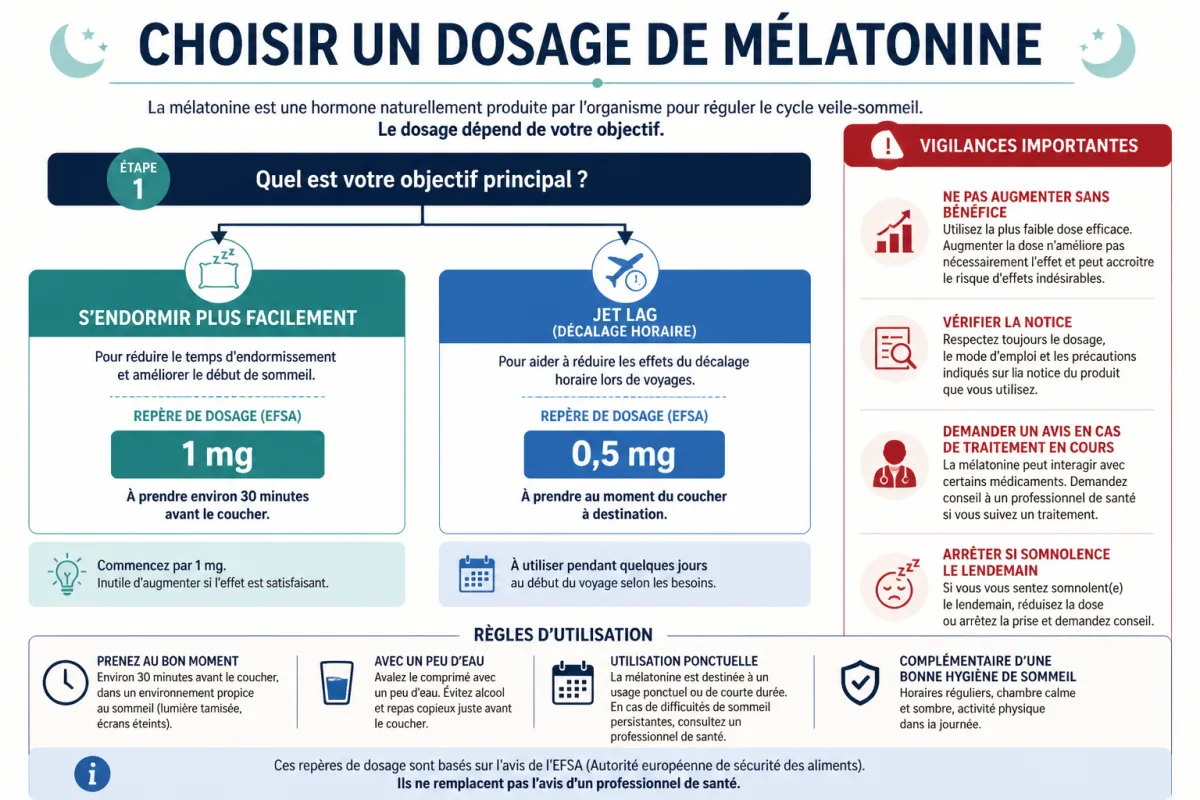
The useful dosage is the one that meets a specific need, not the one that gives the impression of being stronger. In practice, increasing the dose without reviewing the time of intake, evening light, or the cause of the disorder rarely brings a clear benefit.
Before buying, the question is not only “which dose?”, but also “which type of product?”. The distinction between simple use and more supervised use also deserves to be reviewed in the difference between supplement and dietary supplement.
- Read the dose per intake, not just per box.
- Check the product form: fast action or prolonged release.
- Start with the most cautious reference consistent with the goal.
- Avoid combining several sleep products without advice.
- Observe the response over a few evenings before changing the dose.
How to take melatonin to maximize its effectiveness?
Taking melatonin is especially useful when it is part of a simple routine: regular bedtime, dimmed light, no alcohol, and intake close to the expected time of falling asleep. The product leaflet remains a priority, as immediate or prolonged release forms are not taken at the same time.
If taking it feels more like a reflex than a specific need, rereading should you take dietary supplements helps to put the tool in its place. Melatonin only makes sense if it fits into a coherent sleep strategy.
- Choose a clear goal: falling asleep, jet lag or occasional trial.
- Read the dose per intake and the galenic form.
- Take the product in the evening, at the time indicated on the leaflet.
- Reduce light and stimulation immediately after.
- Note the effect over two to five nights before changing anything.
A coherent evening often counts more than a higher dose.
What precautions, side effects, and interactions should be known?
Melatonin remains a product to check before use, especially if a treatment is already in place. ANSES points out precautions for people on medication, during pregnancy and breastfeeding, and for people with chronic diseases; next-day drowsiness, headaches, and dizziness are also signals to watch for.
Interactions to check before the first dose
Melatonin interactions are not all the same, but the common point remains caution whenever a treatment already affects sleep, coagulation, blood sugar, or immunity. In case of chronic treatment, the opinion of a doctor or pharmacist is better than a one-off trial.
| Profile or treatment | Why caution is necessary | Prudent action |
|---|---|---|
| Treatment that influences coagulation | Interactions are reported by ANSES | Ask for the opinion of a doctor or pharmacist |
| Diabetes treatment | Vigilance is recommended regarding blood sugar | Check before starting |
| Immunosuppressants | The immune condition requires increased caution | Avoid self-medication |
| Antiepileptics or sedatives | Drowsiness may accumulate | Do not combine without advice |
| Pregnancy and breastfeeding | Data are insufficient to trivialize use | Seek professional advice |
Side effects to watch for
The most frequently cited side effects in leaflets and reference sheets mainly concern drowsiness, headaches, dizziness, and sometimes more intense dreams. If one of these signs is bothersome the next day, the product is not necessarily suitable, or the dosage should be reassessed.
- Unusual drowsiness upon waking.
- Headaches or a heavy head sensation.
- Dizziness or discomfort after taking it.
- Combination with several sedative products.
- No effect despite correct use over several nights.
An apparently ordinary product can become poorly suited as soon as a treatment, pregnancy, or chronic pathology comes into play.
When is melatonin not enough?
Melatonin does not effectively resolve nights disturbed by pain, anxiety, repeated awakenings, or a sleep-related breathing disorder. When insomnia sets in, daytime fatigue increases, or the problem recurs several times a week, a broader diagnosis becomes more useful than a simple dosage change.
In children and adolescents
In children and adolescents, melatonin can sometimes be used within a specific medical framework, notably for a phase delay, but sleep and habit assessment remains essential. Use without follow-up is less relevant because behavioral and school-related causes are frequent.
In the elderly
In the elderly, the feeling of sleep can be fragmented by nighttime awakenings, medications, or pain. Melatonin can then be a supplement, but it does not replace the search for the cause of awakening.
- Loud snoring or suspected breathing pauses.
- Awakenings with a sensation of suffocation.
- Significant daytime drowsiness.
- Persistent insomnia despite well-managed use.
- Severely altered mood or marked anxiety related to sleep.
For those who want to better situate the place of the supplement in an overall routine, which supplement for anemia is not directly related to sleep but recalls a useful logic: a supplement must meet an identified need, not a vague expectation.
Practical advice for daily use
The best results appear when melatonin is part of a simple routine: same bedtime, lower light, caffeine avoided late in the day, and intake limited to the targeted goal. The question is not only “how much?” but also “under what conditions?” to give the internal clock a chance to reset.
In this logic, melatonin works better as occasional support than as a permanent solution. Reading should you take dietary supplements can also help decide if adding a product truly benefits the evening routine.
- Reserve intake for a clear and time-limited goal.
- Avoid alcohol in the evening, as it disrupts sleep quality.
- Do not combine multiple sleep products without validation.
- Turn off or reduce screens and bright light before bedtime.
- Consult a professional if sleep remains poor despite correct use.
Useful sources to consult
| Source | Useful data | Practical use | Precaution |
|---|---|---|---|
| Inserm | Role of melatonin and impact of light | Understand the mechanism before buying a product | Do not look for a dosing scheme here |
| EFSA | Claim recognized for 1 mg before bedtime and 0.5 mg for jet lag | Have a concrete efficacy benchmark | Do not extrapolate to all insomnia |
| ANSES | Precautions and interactions of melatonin-based supplements | Check treatments and vulnerable conditions | Seek advice if in doubt |
| Vidal | Active substance sheet, side effects and contraindications | Complete verification before purchase or use | Does not replace medical consultation |
Key takeaways
- 🌙 Melatonin mainly helps with falling asleep, not all types of insomnia.
- 💊 The most solid benchmark for falling asleep is 1 mg before bedtime.
- 🕒 The time of intake and product form matter as much as the dose.
- ⚠️ Current treatments, pregnancy, and chronic diseases require professional advice.
- 🧭 If sleep remains poor, the cause should be sought rather than increasing the dose.
Frequently Asked Questions
Does melatonin really make you sleep?
Melatonin mainly helps promote falling asleep when the internal clock is delayed or disrupted. It does not force sleep like a sleeping pill, and its effect varies depending on the cause of the disorder. EFSA and Inserm present it mainly as a night signal rather than a strong sedative product.
Can you take melatonin every night?
Daily use is not automatically problematic, but it should not become a habit without questioning. If intake becomes regular, the right reflex is to check the cause of the difficult sleep and seek advice, especially if the product has been used for several weeks.
How long before bedtime should it be taken?
Intake is generally in the evening, before bedtime, with the delay indicated on the product leaflet. The galenic form matters a lot: a fast-acting formula is not used like a prolonged-release formula. The leaflet therefore remains the safest reference.
Does melatonin cause drowsiness the next day?
Next-day drowsiness can appear in some people, especially if the dose is too high, if the intake is too late, or if the product is combined with other sedative substances. This signal should be taken seriously, as it often indicates that the usage scheme needs to be revised.
Who should avoid melatonin or seek advice before taking it?
People under treatment, pregnant or breastfeeding women, and people with chronic diseases should seek professional advice before any intake. ANSES emphasizes this caution, as the risk does not come only from the product itself but also from the condition and possible interactions.
