

Sommaire
Decoding the Label of a Mushroom-Based Supplement
Reading the label of a mushroom supplement is often where the real sorting happens. The name of the mushroom on the front sells, but the useful truth hides on the back: part used, product form, amount of active ingredients, quality controls, and mandatory mentions. In other words, if the packaging talks loudly but says little, you need to set things straight.
In brief
🧭 Start with the part used: mycelium, fruiting body, or blend. This is often the information that most changes the product’s reading.
🔬 Beta-glucans and polysaccharides do not mean the same thing. The first indicator is more useful, provided it is clearly stated.
📦 A readable label also specifies the extract, the ratio, the traceability, and quality controls. Without this, marketing takes over.
⚠️ The right reflex is to compare two labels line by line, not to be impressed by the total weight or the promises on the front.
How to read a mushroom supplement label in 60 seconds?
The short answer is simple: first look at what the product actually uses, then what it measures. To read a mushroom supplement label without getting lost, you need to spot three blocks of information: the part of the mushroom, the product form, and the numbers that make sense. The rest, often, is mostly packaging.
To read a label of a mushroom-based supplement, first check the part used, then the product form, and finally the announced actives. A good label clearly distinguishes mycelium and fruiting body, specifies the extract and ratio, and does not settle for a total weight or vague marketing talk.
On a serious label, the mandatory mentions are not a minor detail. The term “dietary supplement” must appear, the list of ingredients must be given in descending order, the recommended daily dose must be indicated with the instructions for use, and the amounts of nutrients must be expressed as a percentage of the RDA per daily dose. The expiration date and storage conditions must also be on the packaging. This foundation allows you to read the rest with a minimum of perspective, as reminded by the VIDAL sheet on labels.

Beta-glucans, mycelium or fruiting body: what should you look at?
The right reflex is not to look for the most impressive word, but the one that most precisely describes the raw material. If the label distinguishes the mycelium from the fruiting body, it already becomes much more readable. And if it displays a percentage of beta-glucans rather than a simple total of polysaccharides, we start talking about something comparable.
The mycelium corresponds to the filamentous network of the mushroom. On a label, this mention does not say everything: you also need to know on which substrate it was cultivated. When the mycelium is grown on cereals, part of the final product may be linked to the residual starch of the substrate. The point is not to demonize this form, but to understand what it really measures. On this point, a dedicated guide can help choose a truly quality formula.
The fruiting body corresponds to the visible part of the mushroom, the one most often harvested to make better-identified extracts. When a brand clearly mentions it, with the Latin name of the species and the extraction method, it makes comparison easier. It is not an automatic guarantee of quality, but it is already a much stronger signal of transparency than a simple common name printed in large letters.

A readable label does not seek to make you dream. It seeks to describe what is really in the bottle.
Beta-glucans and polysaccharides: the nuance that avoids mistakes
Beta-glucans are a fraction of polysaccharides. In other words, every beta-glucan is a polysaccharide, but the reverse is not true. This is precisely why a polysaccharide content alone can be misleading: it sometimes includes sugars or compounds that say little about the actual quality of the mushroom. If the label displays beta-glucans, that’s better; if it also details the measurement method, that’s even better.
A common mistake is to confuse 30% polysaccharides with 30% beta-glucans. In practice, these are not the same indicator, and comparison between products quickly becomes distorted if the formula does not clearly explain what it measures.
Which numbers really deserve your attention?
The right product is not necessarily the one that displays the highest number on the front. On a mushroom supplement label, the real challenge is to understand what the number refers to: raw powder, extract, daily dose, or the truly standardized active fraction. This is where many comparisons go off track, because a “1,000 mg” means nothing on its own.
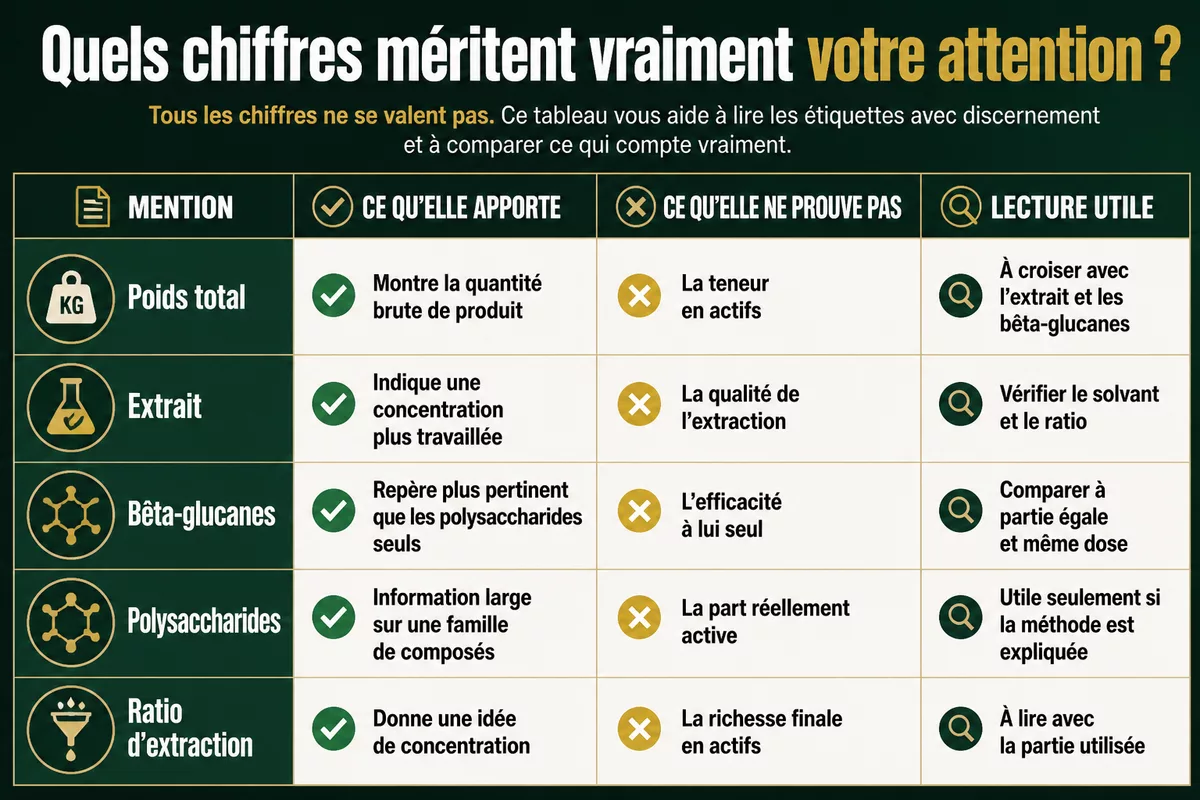
| Mention | What it provides | What it does not prove | Useful reading |
|---|---|---|---|
| Total weight | Shows the raw quantity of product | The active content | To be cross-checked with extract and beta-glucans |
| Extract | Indicates a more processed concentration | The quality of the extraction | Check the solvent and the ratio |
| Beta-glucans | A more relevant marker than polysaccharides alone | Effectiveness by itself | Compare on an equal basis and same dose |
| Polysaccharides | Broad information on a family of compounds | The truly active portion | Useful only if the method is explained |
| Extraction ratio | Gives an idea of concentration | The final richness in actives | To be read with the part used |
In practice, the logic remains the same: a powder and an extract do not tell the same story. A well-presented mushroom extract generally mentions the part used, the extraction method, sometimes the solvent used — hot water, alcohol, double extraction — and ideally, the beta-glucan content. On this point, the comparison between chaga powder or extract is telling: the number alone is never enough, you need to know what it measures.
Standardization provides a useful reference point, but it doesn’t do everything. It indicates that a product is adjusted to reach a target content, for example in beta-glucans. However, it does not guarantee origin, purity, or absence of contaminants. This is where label quality becomes truly interesting: it separates measurable information from flattering talk.
The best indicator is not the most spectacular one, but the one that can be effortlessly linked to the raw material and the manufacturing method.
Mentions that inspire confidence on a real label
A solid label does not scatter. It names the species, specifies the part used, explains the product form, and provides traceability elements. When these points are absent, the product may still be acceptable, but it becomes much harder to judge. And when comparing two similar references, it is precisely these details that make the difference.
- Latin name of the mushroom: it avoids ambiguities between close species.
- Part used: mycelium, fruiting body, or blend, with clear mention.
- Origin and cultivation method: wild-harvested, cultivated, on wood or on cereals.
- Type of extraction: powder, aqueous extract, alcoholic extract, or double extraction.
- Quality controls: analyses of contaminants, residual solvents, or purity.
In a quick-reading logic, the presence of information such as extraction ratio or beta-glucan percentage only really matters if they are consistent with each other. That is why some buyers compare the overall structure of the formula before looking at the price. A well-documented product looks less like a promise and more like an honest technical sheet.
A good dietary supplement should never claim to prevent or treat a disease. The rule is simple: prevention or treatment claims are prohibited on this type of product, and the European framework on dietary supplements clearly reminds this. To go further, the legal basis can be consulted on the European directive on dietary supplements.
The simple method to compare two labels in-store or online
If you need to compare two products in less than a minute, keep a fixed method. The classic trap is to first look at the price or the jar’s photo. In reality, you must read the back, then return to the front. That is where the gap between a clear formula and a vague formula hides.
- Identify the part used: mycelium, fruiting body, or blend.
- Check the form: simple powder or concentrated extract.
- Look for the announced active: beta-glucans, not just polysaccharides.
- Note the ratio and extraction method if specified.
- Check traceability: origin, Latin name, purity, analyses.
Simple example: a bottle A displays “reishi extract 500 mg, 30% beta-glucans, aqueous extract 8:1.” A bottle B only indicates “reishi 500 mg” with a big headline about energy. The first does not necessarily promise better, but it allows comparison. The second mostly lets you guess what it really contains.
That is exactly why a guide on the cultivation and standardization of adaptogenic mushrooms can complement label reading: it helps better understand what is at stake between raw material, extraction, and final control.
What are the warning signs of a vague label?
There are formulations that immediately inspire caution. They do not necessarily mean that the product is bad, but they indicate incomplete or hard-to-read information. The problem is not the marketing style itself; it is when style replaces information. And there, the reader loses track.
- The word “mushroom” appears, but not the Latin name of the species.
- The front side promises a lot, but the back side does not indicate the part used.
- The product displays polysaccharides, without ever mentioning beta-glucans.
- The jar gives a total weight, without specifying whether it is a powder or an extract.
- No trace of traceability, analyses, or quality control appears.
The most frequent point of vigilance concerns formulas based on mycelium cultivated on cereals. Without details on the substrate, extraction, and measured actives, it is unclear whether one is comparing a concentrated extract or a product more diluted in its support.
Another warning sign is piling up technical terms without logic. “Standardized,” “concentrated,” “pure,” “active”: these words can coexist without any proving quality. The right question always remains the same: what is measured, how, and on which part of the mushroom? If the answer is not clear, the product’s readability is not either.
A good packaging reassures. A good label allows to decide.
Key takeaways
🧪 First look at the part used, not just the mushroom’s name.
📊 Prefer a percentage of beta-glucans over an isolated total of polysaccharides.
🔎 Extract, ratio, solvent, and standardization must be readable together.
🛡️ Traceability and quality controls count as much as the displayed dosage.
🚦 If the label remains vague, compare with a more explicit formula before buying.
FAQ
Are beta-glucans the only criterion to look at?
No, but it is one of the most useful. A good label reading combines beta-glucan content, the part used, the product form, and traceability. An isolated figure is not enough if the rest of the formula remains vague.
Is mycelium necessarily less interesting than the fruiting body?
Not necessarily. The real issue is transparency: one needs to know on which substrate it was cultivated, which fraction is standardized, and which actives are really measured. Without these details, the comparison becomes shaky.
Is a powder and an extract the same thing?
No. Powder corresponds to a more raw raw material, whereas an extract is obtained by a process that concentrates certain fractions of the mushroom. The ratio, solvent, and standardization help understand what the product is really worth.
How to spot a label that is too marketing?
When promises are very visible but the part used, Latin name, or beta-glucans are not specified, you need to slow down. A serious label is readable before being attractive.
What should be checked first before buying online?
Start with the part used, the product form, beta-glucan content, and quality control indicators. Only then compare the price, because a cheaper product may be less documented, and therefore less comparable.
