

.mg-callout>:first-child{margin-top:0}.mg-callout>:last-child{margin-bottom:0}.mg-callout__label{display:block;margin:0 0 .35em;font-weight:700;font-size:.82em;letter-spacing:.03em;text-transform:uppercase}.mg-callout__label::before{margin-right:.45em;font-size:1.05em;vertical-align:-.06em}.mg-callout–info{background:#eff6ff;border-color:#bfdbfe;color:#1e3a5f}.mg-callout–info .mg-callout__label{color:#2563eb}.mg-callout–info .mg-callout__label::before{content:”\2139\FE0F”}.mg-callout–tip{background:#f0fdf4;border-color:#bbf7d0;color:#14532d}.mg-callout–tip .mg-callout__label{color:#15803d}.mg-callout–tip .mg-callout__label::before{content:”\1F4A1″}.mg-callout–warning{background:#fffbeb;border-color:#fde68a;color:#7a4a10}.mg-callout–warning .mg-callout__label{color:#b45309}.mg-callout–warning .mg-callout__label::before{content:”\26A0\FE0F”}.mg-callout–danger{background:#fef2f2;border-color:#fecaca;color:#7f1d1d}.mg-callout–danger .mg-callout__label{color:#dc2626}.mg-callout–danger .mg-callout__label::before{content:”\1F6D1″}.mg-proscons{display:grid;grid-template-columns:1fr 1fr;gap:16px;margin:1.5em 0}@media(max-width:560px){.mg-proscons{grid-template-columns:1fr}}.mg-proscons__col{padding:.9em 1.1em;border:1px solid;border-radius:10px}.mg-proscons__title{display:flex;align-items:center;gap:.4em;margin:0 0 .5em;font-weight:700;font-size:.9em;letter-spacing:.02em}.mg-proscons__col ul{margin:.3em 0 0;padding-left:1.15em}.mg-proscons__col li{margin:.3em 0;line-height:1.55}.mg-proscons__col–pro{background:#f0fdf4;border-color:#bbf7d0;color:#14532d}.mg-proscons__col–pro .mg-proscons__title{color:#15803d}.mg-proscons__col–pro .mg-proscons__title::before{content:”\2705″}.mg-proscons__col–con{background:#fef2f2;border-color:#fecaca;color:#7f1d1d}.mg-proscons__col–con .mg-proscons__title{color:#dc2626}.mg-proscons__col–con .mg-proscons__title::before{content:”\274C”}ol.mg-steps{list-style:none!important;counter-reset:mgstep;margin:1.6em 0;padding-left:0!important}ol.mg-steps>li.mg-steps__item{counter-increment:mgstep;list-style:none!important;padding-left:0!important;padding-bottom:1.4em}ol.mg-steps>li.mg-steps__item:last-child{padding-bottom:0}ol.mg-steps>li.mg-steps__item>:last-child{margin-bottom:0}ol.mg-steps>li.mg-steps__item>.mg-steps__title{margin:0 0 .25em;font-weight:600}ol.mg-steps>li.mg-steps__item>.mg-steps__title::before{content:counter(mgstep) “. “;opacity:.45;font-weight:500;font-variant-numeric:tabular-nums}ol.mg-steps>li.mg-steps__item:not(:has(.mg-steps__title))::before{content:counter(mgstep) “. “;opacity:.45;font-weight:500;font-variant-numeric:tabular-nums}.mg-kpis{display:grid;grid-template-columns:repeat(auto-fit,minmax(140px,1fr));gap:14px;margin:1.5em 0}.mg-kpi{padding:1em .9em;border:1px solid #e5e7eb;border-radius:12px;background:#f9fafb;text-align:center}.mg-kpi__value{display:block;font-size:1.7em;font-weight:800;line-height:1.15;color:#111827}.mg-kpi__label{display:block;margin-top:.35em;font-size:.85em;color:#6b7280;line-height:1.35}
.wp-block-image,.ai-image{margin-bottom:1.75em}.wp-block-image>figcaption,.ai-image>figcaption{margin-top:.5em}
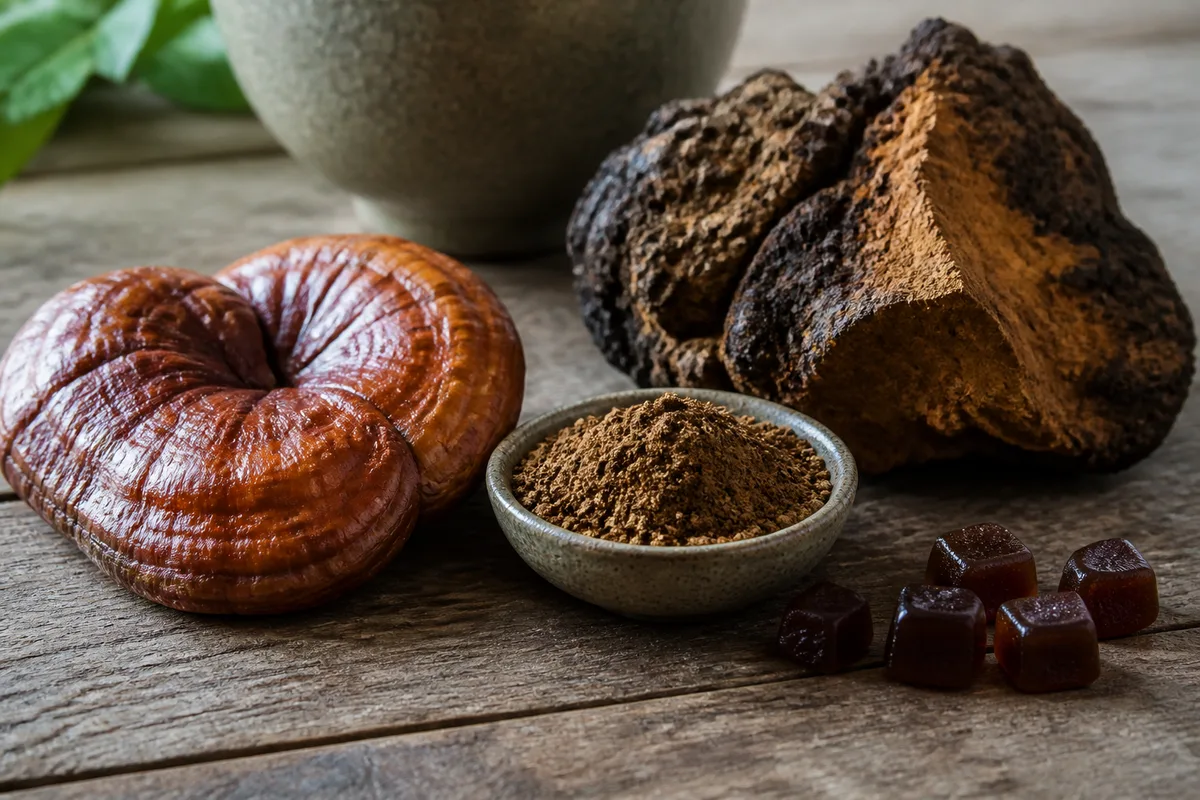
Functional mushroom gummies are chewable dietary supplements, formulated with one or more mushrooms such as reishi, chaga, lion’s mane, or cordyceps. They also contain a sweetened or sugar-free base, a gelling agent, flavorings, and sometimes vitamins or minerals. Their practical appeal is real, while the claimed health benefits should be examined methodically.
A label may state “2,500 mg of mushrooms” without specifying whether it is powder, a concentrated extract, a blend, or a total amount per box. This nuance changes how the product is interpreted. In 2026, the right approach is therefore to separate the species used, the amount per serving, the declared compounds, the excipients, and the level of evidence for the claims.
Sommaire
What are functional mushroom gummies?
Functional mushroom gummies are chewable gums presented as dietary supplements. They generally combine mushroom powders or extracts with a gelled base, sugar or a sweetener, flavorings, and sometimes added nutrients. They may contain a single species or a blend of several mushrooms.
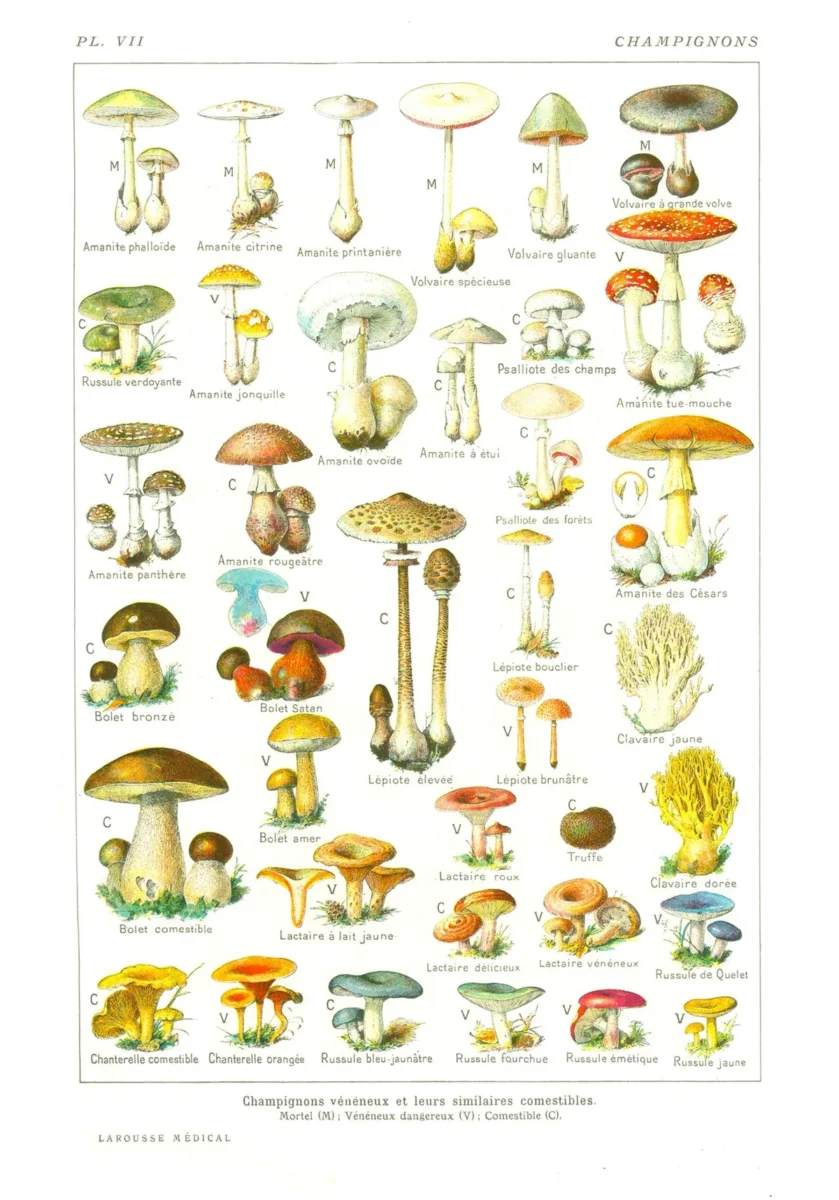
The word “functional” mainly relates to commercial and nutritional positioning. It does not turn a gummy into a medicine.
A gummy can thus be vegan, blackcurrant-flavored, or enriched with zinc, without this presentation establishing efficacy on memory, immunity, fatigue, or skin. Authorized claims for vitamins and minerals must be distinguished from the general promises associated with mushrooms.
Actual composition of a mushroom gummy
A gummy rarely contains only one mushroom. Its actual composition combines a fungal raw material, a sweetened or sugar-free matrix, a gelling agent, flavorings, possible colorants, and sometimes vitamins, minerals, or other substances like L-theanine.

Ingredients derived from mushrooms
The most important part to identify is the form used: mushroom powder, extract, mycelium, or blend whose exact proportion is sometimes little detailed. A transparent manufacturer indicates the species, the part used, the amount per serving, and, when relevant, the extraction ratio or beta-glucan content.
A high total weight is not enough to judge the formula. A mention of 2,500 mg may add several species, correspond to a raw powder, or refer to a theoretical quantity derived from an extraction ratio.
Sugar, sweeteners, and the gelled base
The soft texture comes from a base that may combine syrup, sugar, pectin, gelatin, or polyols. The vegan label generally signals the absence of animal gelatin when claimed by the manufacturer, without alone informing the sugar content or nutritional density.
To verify the formula, read the nutrition facts table and the ingredient list separately. “Sugar-free” may correspond to the use of sweeteners, while a sweetened formula may show a variable amount of carbohydrates per serving.
Added Flavors, Colorants, and Active Ingredients
Flavors provide the taste, often red fruits or blackcurrant, and colorants alter the appearance. Some products add zinc, niacin, pantothenic acid, vitamin B12, iodine, ginseng, or L-theanine.
These additions complicate the analysis. A formula combining six mushrooms and several vitamins does not allow automatically attributing an effect to a specific species.
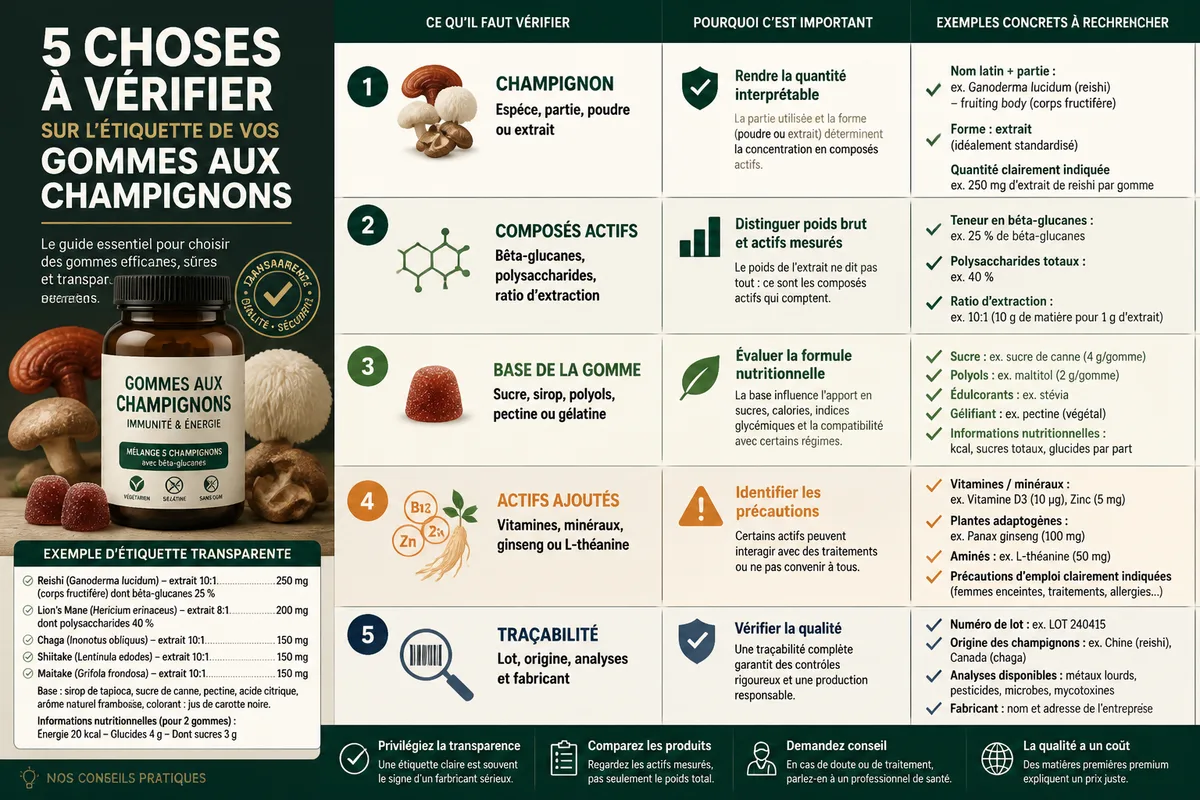
| Ingredient Family | What to Check | Why It Matters |
|---|---|---|
| Mushroom | Species, part, powder or extract | The declared quantity becomes interpretable |
| Active Compounds | Beta-glucans, polysaccharides, extraction ratio | Avoids confusing gross weight with measured actives |
| Gummy Base | Sugar, syrup, polyols, pectin or gelatin | Allows evaluation of the nutritional formula |
| Added Actives | Vitamins, minerals, ginseng or L-theanine | Precautions may concern the entire formula |
| Traceability | Batch, origin, analyses and manufacturer | Facilitates quality verification |
Which Mushrooms Are Most Commonly Found?
Commercial recipes often mention reishi, chaga, lion’s mane, cordyceps, maitake, and tremella. Their presence does not mean that each gummy contains all six species, nor that their quantity or form are comparable from one product to another.
Reishi, Lion’s Mane, and Cordyceps
Reishi generally corresponds to Ganoderma lucidum, lion’s mane to Hericium erinaceus, and cordyceps to a group of mushrooms whose commercial names must be read carefully. Labels may refer to powder, extract, or mycelium.
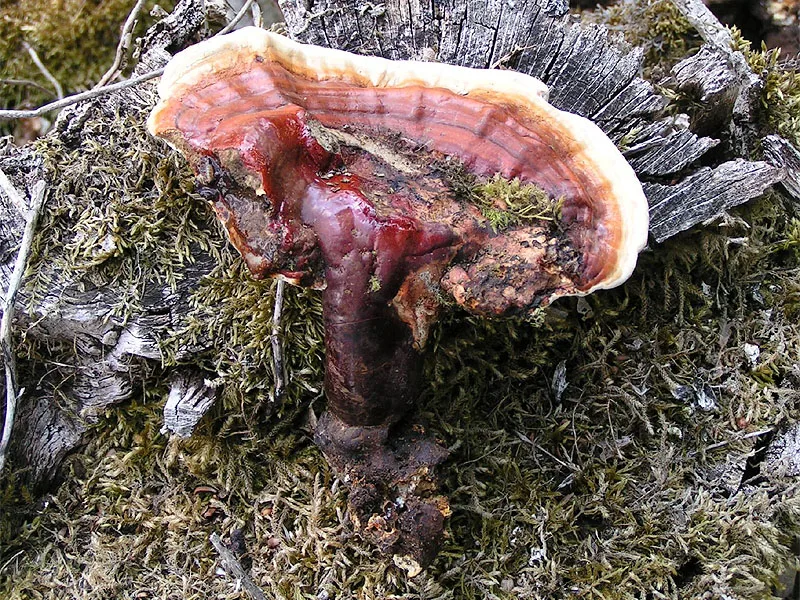
Products combining reishi, lion’s mane, and cordyceps therefore include distinct ingredients, with scientific data specific to each species and each preparation. To explore the case of reishi further, see this analysis on the evidence regarding reishi.
Chaga, Maitake, and Tremella
Chaga, maitake, and tremella also appear in multi-mushroom formulas. Their name on the label is not enough to know the part used, extraction solvent, polysaccharide content, or the actual amount provided by one gummy.

A concrete example shows the importance of this verification: Naturecan indicates, for two gummies, 1,500 mg of maitake, 200 mg of reishi, 100 mg of lion’s mane, 100 mg of chaga, 20 mg of cordyceps, and 10 mg of tremella, as well as 30 mg of L-theanine, 28 mg of ginseng, 12 mg of pantothenic acid, and 100 µg of iodine, according to its product sheet. These figures describe this specific product.
How to read a label in five steps?
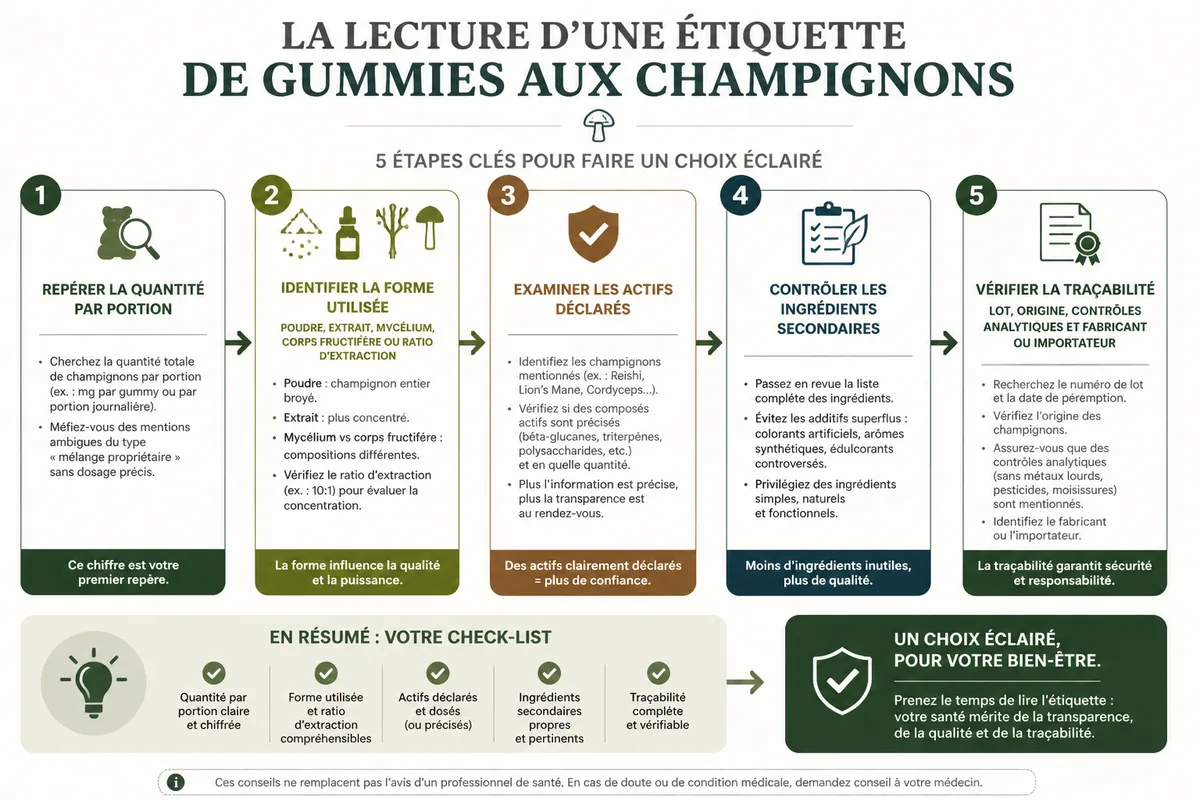
To read a label on functional mushroom gummies, start with the daily serving size, then check the form of the mushroom, the measured active ingredients, the excipients, and the traceability. This sequence prevents judging a formula solely by the number of species or by a promise printed on the front.
- Identify the amount per serving. Note the number of gummies and the total weight assigned to this serving, without extrapolating to another brand.
- Identify the form used. Look for the words powder, extract, mycelium, fruiting body, and extraction ratio.
- Examine the declared active ingredients. A content of beta-glucans or polysaccharides is more informative than an undetailed overall weight.
- Check the secondary ingredients. Verify sugar, polyols, gelling agents, flavors, colorants, vitamins, minerals, and added plants.
- Verify traceability. Look for the batch number, origin, analytical controls, and the identity of the manufacturer or importer.
The serving size announced by Protein Works is two gummies per day for its Mushroom Gummies Extra product, while a Naturecan page presents inconsistent dosage indications depending on its sections. Never accept a contradictory dose without direct clarification on the label or from the manufacturer.
The practical rule is clear: a recommendation specific to one brand never becomes a general dosage for all gummies.
Are the health claims proven?
Gummies may display claims related to cognition, energy, immunity, or skin, while relying on very different levels of evidence. Results obtained in the laboratory or on animal models alone do not allow concluding that a given gummy produces the same effect in humans.
Beta-glucans and polysaccharides are families of compounds studied in several mushrooms. Their presence provides compositional information. It is not sufficient to establish a clinical benefit with the dosage, extract, and frequency of intake of the purchased product.
National Geographic reports that the available research is not yet sufficient to firmly establish the health benefits of medicinal mushrooms in humans, and reminds that laboratory results do not necessarily translate to human clinical trials. This distinction must remain visible on every label.
A common misconception circulates: “if the mushroom is natural, the gummy is necessarily effective and risk-free.” The actual composition disproves this shortcut: a gummy may contain sweeteners, vitamins, iodine, or plants, and clinical data vary depending on the extract studied.
To follow the evolution of knowledge without confusing trend and evidence, you can read this summary on the trends of functional mushrooms in 2026.
Mushroom Gummies: Precautions and Possible Side Effects
Functional mushroom gummies require medical or pharmaceutical advice in cases of pregnancy, breastfeeding, allergy, chronic illness, or medication use. Potential risks concern the mushroom, vitamins, minerals, plants, and excipients present in the same formula.
Digestive disorders, nausea, or hypersensitivity reactions should lead to discontinuing use and seeking professional advice. Difficulty breathing, swelling of the face or throat, significant discomfort, or a generalized reaction require immediate contact with local emergency services, notably 112 in Europe.
People taking anticoagulant, antidiabetic, antihypertensive, or immunomodulatory treatments should present the complete list of ingredients to a healthcare professional before any use. Caution also applies to people with liver or kidney disease, as well as children and adolescents.
Do not alter a prescribed treatment to take gummies. Do not combine multiple supplements containing the same vitamins or minerals without controlling the total amount.
How to Choose a More Transparent Product in 2026?
A more transparent product clearly indicates the species, the part used, the amount per serving, the powder or extract form, the measured active ingredients, excipients, and the batch number. It also allows identifying the manufacturer and understanding the announced controls, without presenting a quality test as proof of medical efficacy.
In this case, choose the formula that details each mushroom. Avoid those that only display a proprietary blend without usable quantities.
- Prefer an amount indicated by species and per serving.
- Look for the extraction ratio when claimed by the manufacturer.
- Check the sugar, polyols, and carbohydrate content.
- Spot added vitamins, minerals, and plants.
- Request batch analyses when contaminants or authenticity are at stake.
- Verify consistency between packaging, product sheet, and announced dose.
Prices only illustrate commercial volatility: Protein Works displayed €17.99 for a box of 40 gummies, while Naturecan showed €13.99 instead of €19.99 for 60 gummies at the time of the survey. These amounts should be rechecked on official pages before purchase.
Gummies, Capsules, or Powder: Which Format to Prefer?
Gummies prioritize taste and ease of transport, capsules often reduce added flavors, and powders allow more direct adjustment of the weighed amount. No format alone guarantees better efficacy or superior absorption.
| Format | Practical Advantage | Point to Check | For Which Use |
|---|---|---|---|
| Gummies | Intake without water and refined taste | Sugar, sweeteners, and dose per gummy | On-the-go routine and preference for chewing |
| Capsules | Often more compact formula | Extract amount and excipients | Person who wants to avoid a sugary base |
| Powder | Measurable and mixable quantity | Taste, solubility, and measurement precision | Home use with clearly provided dose |
Gummies are suitable here, capsules are not: a person strictly monitoring sugars should prefer a formula whose nutritional table is verifiable.
Summary Table for Decoding a Label
The following table serves as a quick guide before purchase. A detailed mention reduces uncertainty about the content, while a general formula requires requesting additional information from the manufacturer.
| Element read | Satisfactory information | Warning sign |
|---|---|---|
| Species | Common name and scientific name | “Mushroom complex” without detail |
| Quantity | Milligrams per serving and per species | Overall figure on the front face |
| Form | Powder, extract, mycelium or fruiting body clearly specified | Form absent |
| Actives | Quantified beta-glucans or polysaccharides | “Powerful actives” without value |
| Base | Sugar, polyols and gelling agent identifiable | List difficult to link to the nutritional table |
| Controls | Batch, analyses and responsible party identified | Quality promise without verifiable document |
Frequently Asked Questions about Functional Mushroom Gummies
Do gummies really contain mushrooms?
Yes, when a mushroom powder or extract actually appears in the ingredient list. However, the quantity, species, and part used must be verified separately.
Are mushroom gummies often sweetened?
They may contain sugar, syrup, polyols, or other sweeteners. Only the nutritional table associated with the ingredient list allows knowing the exact formula.
What is the difference between mycelium and fruiting body?
Mycelium corresponds to the network of fungal filaments, while the fruiting body is the structure generally visible at maturity. Their compositions may differ: the label must specify the material used.
Can these gummies be taken every day?
The frequency indicated by the manufacturer applies to their specific formula. In case of treatment, pregnancy, breastfeeding, illness, allergy, or doubt about a conflicting dose, seek advice from a doctor or pharmacist.
Do functional mushrooms replace medication?
No. Gummies are dietary supplements and do not replace diagnosis, prescribed treatment, or medical follow-up.
How to spot a non-transparent formula?
A non-transparent formula displays a general mixture without quantity per species, without clearly identified form, and without verifiable information on batch or controls. In this case, move on.
Useful Sources to Consult
To verify a claim, read the manufacturer’s official documentation for composition and serving size, then consult the National Agency for Food, Environmental and Occupational Health Safety for general food safety and supplement questions. The European Food Safety Authority provides scientific evaluations and authorized nutritional claims at the European level.
For an interaction, allergy, or personal situation, the pharmacist and doctor remain the appropriate contacts. The product pages of Protein Works and Naturecan allow checking the cited commercial compositions, as well as their possible updates.
(function(){
var ov=document.getElementById(‘magic-lb’);if(!ov)return;
var img=ov.querySelector(‘img’),btn=ov.querySelector(‘.magic-lb-close’);
function open(src){img.src=src;ov.classList.add(‘open’);document.body.style.overflow=’hidden’}
function close(){ov.classList.remove(‘open’);img.src=”;document.body.style.overflow=”}
document.addEventListener(‘click’,function(e){
var a=e.target.closest(‘a.magic-img-link’);
if(a){e.preventDefault();open(a.getAttribute(‘href’));return}
var i=e.target.closest(‘.wp-block-image img’);
if(i&&!e.target.closest(‘a’)){e.preventDefault();open(i.currentSrc||i.src)}
});
ov.addEventListener(‘click’,function(e){if(e.target===ov||e.target===btn)close()});
document.addEventListener(‘keydown’,function(e){if(e.key===’Escape’)close()});
})();
