

.mg-callout>:first-child{margin-top:0}.mg-callout>:last-child{margin-bottom:0}.mg-callout__label{display:block;margin:0 0 .35em;font-weight:700;font-size:.82em;letter-spacing:.03em;text-transform:uppercase}.mg-callout__label::before{margin-right:.45em;font-size:1.05em;vertical-align:-.06em}.mg-callout–info{background:#eff6ff;border-color:#bfdbfe;color:#1e3a5f}.mg-callout–info .mg-callout__label{color:#2563eb}.mg-callout–info .mg-callout__label::before{content:”\2139\FE0F”}.mg-callout–tip{background:#f0fdf4;border-color:#bbf7d0;color:#14532d}.mg-callout–tip .mg-callout__label{color:#15803d}.mg-callout–tip .mg-callout__label::before{content:”\1F4A1″}.mg-callout–warning{background:#fffbeb;border-color:#fde68a;color:#7a4a10}.mg-callout–warning .mg-callout__label{color:#b45309}.mg-callout–warning .mg-callout__label::before{content:”\26A0\FE0F”}.mg-callout–danger{background:#fef2f2;border-color:#fecaca;color:#7f1d1d}.mg-callout–danger .mg-callout__label{color:#dc2626}.mg-callout–danger .mg-callout__label::before{content:”\1F6D1″}.mg-proscons{display:grid;grid-template-columns:1fr 1fr;gap:16px;margin:1.5em 0}@media(max-width:560px){.mg-proscons{grid-template-columns:1fr}}.mg-proscons__col{padding:.9em 1.1em;border:1px solid;border-radius:10px}.mg-proscons__title{display:flex;align-items:center;gap:.4em;margin:0 0 .5em;font-weight:700;font-size:.9em;letter-spacing:.02em}.mg-proscons__col ul{margin:.3em 0 0;padding-left:1.15em}.mg-proscons__col li{margin:.3em 0;line-height:1.55}.mg-proscons__col–pro{background:#f0fdf4;border-color:#bbf7d0;color:#14532d}.mg-proscons__col–pro .mg-proscons__title{color:#15803d}.mg-proscons__col–pro .mg-proscons__title::before{content:”\2705″}.mg-proscons__col–con{background:#fef2f2;border-color:#fecaca;color:#7f1d1d}.mg-proscons__col–con .mg-proscons__title{color:#dc2626}.mg-proscons__col–con .mg-proscons__title::before{content:”\274C”}ol.mg-steps{list-style:none!important;counter-reset:mgstep;margin:1.6em 0;padding-left:0!important}ol.mg-steps>li.mg-steps__item{counter-increment:mgstep;list-style:none!important;padding-left:0!important;padding-bottom:1.4em}ol.mg-steps>li.mg-steps__item:last-child{padding-bottom:0}ol.mg-steps>li.mg-steps__item>:last-child{margin-bottom:0}ol.mg-steps>li.mg-steps__item>.mg-steps__title{margin:0 0 .25em;font-weight:600}ol.mg-steps>li.mg-steps__item>.mg-steps__title::before{content:counter(mgstep) “. “;opacity:.45;font-weight:500;font-variant-numeric:tabular-nums}ol.mg-steps>li.mg-steps__item:not(:has(.mg-steps__title))::before{content:counter(mgstep) “. “;opacity:.45;font-weight:500;font-variant-numeric:tabular-nums}.mg-kpis{display:grid;grid-template-columns:repeat(auto-fit,minmax(140px,1fr));gap:14px;margin:1.5em 0}.mg-kpi{padding:1em .9em;border:1px solid #e5e7eb;border-radius:12px;background:#f9fafb;text-align:center}.mg-kpi__value{display:block;font-size:1.7em;font-weight:800;line-height:1.15;color:#111827}.mg-kpi__label{display:block;margin-top:.35em;font-size:.85em;color:#6b7280;line-height:1.35}
.wp-block-image,.ai-image{margin-bottom:1.75em}.wp-block-image>figcaption,.ai-image>figcaption{margin-top:.5em}
The regulation of dietary supplements in 2026 still relies on a dual framework: European Union food law and the French decree no. 2006-352 of March 20, 2006. In France, a product must be declared to the DGAL via Compl’Alim before marketing, while respecting the rules on composition, labeling, claims, and safety.
The key point to remember lies in a distinction often misunderstood: an administrative declaration does not equate to systematic product approval. Dietary supplements do not benefit from a marketing authorization comparable to that of a medicine; however, certain compositions may be subject to special procedures, especially when an ingredient has a specific status or regulatory uncertainty.
Sommaire
To remember in 2026
- Dietary supplements remain foodstuffs.
- Decree no. 2006-352 governs their French regime.
- Declaration via Compl’Alim precedes marketing in France.
- Health claims fall under Regulation (EC) no. 1924/2006.
- Ingredients, plants, and doses must be checked on a case-by-case basis.
- An announced rule does not have the same scope as an applicable text.
What legal status for a dietary supplement in France?
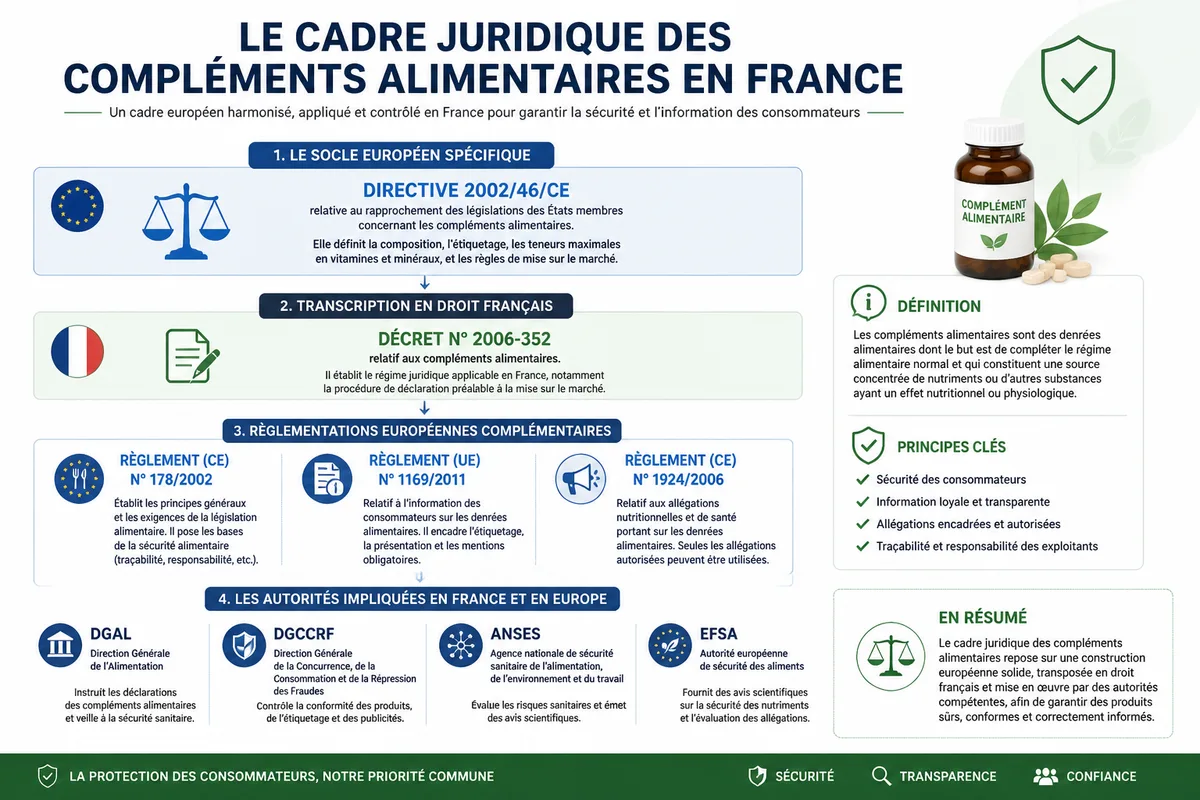
A dietary supplement is a foodstuff intended to complement the normal diet, in forms such as capsules, tablets, ampoules, powders, or liquids. In France, its regulation combines Directive 2002/46/EC, Decree no. 2006-352, and transversal European regulations applicable to safety and consumer information.
A foodstuff, not a medicine
This qualification has concrete consequences. The manufacturer or importer must guarantee the product’s safety, the fairness of its presentation, and the compliance of its ingredients.
The product cannot claim a therapeutic property reserved for medicines. A statement promising to treat a disease, replace a treatment, or cure a disorder would cross a major regulatory line.
The dietary supplement complements the diet. It does not replace a balanced diet or medical advice.
The texts that interlock
Directive 2002/46/EC is the specific European reference. In France, Decree no. 2006-352 of March 20, 2006, specifies notably the national rules relating to dietary supplements, their composition, and their declaration.
Regulation (EC) no. 178/2002 sets the general principles of food safety. Regulation (EU) no. 1169/2011 governs consumer information, while Regulation (EC) no. 1924/2006 applies to nutritional and health claims.
| Text or organization | What it governs | Practical use |
|---|---|---|
| Directive 2002/46/EC | Specific European framework | Understand the common bases within the European Union |
| Decree no. 2006-352 | French regime for dietary supplements | Check national rules and the declaration |
| Regulation (EC) no. 178/2002 | General food safety | Assess product responsibility and safety |
| Regulation (EU) no. 1169/2011 | Consumer information | Control labeling and presentation |
| Regulation (EC) no. 1924/2006 | Nutritional and health claims | Verify promises used on packaging or online |
| DGAL, DGCCRF, Anses and EFSA | Declaration, controls, opinions and monitoring | Identify the appropriate official source for each verification |
How to declare a dietary supplement in France?
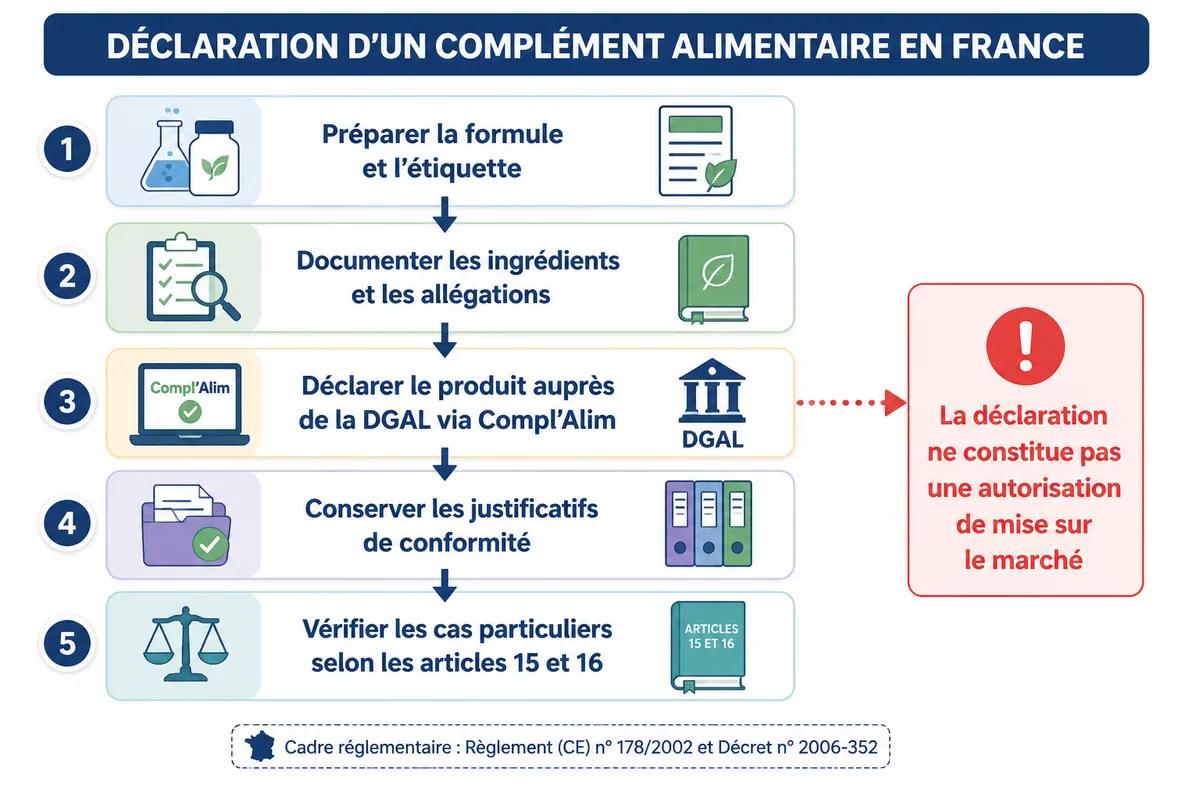
The marketing of a dietary supplement in France requires a declaration to the DGAL via Compl’Alim. This formality concerns the product presented to the French market, with procedures that may vary depending on its composition and the elements of the file; it does not constitute a pharmaceutical-type marketing authorization.
The declaration does not certify compliance
Here is the mistake to avoid: believing that a number or a declaration receipt proves that the formula is compliant.
The declaration transmits information to the administration. The responsibility for compliance remains with the operator who places the product on the market. The DGCCRF or the competent services can then check the composition, labeling, claims, traceability, and sales conditions.
A particular composition may require additional analysis. The status of an ingredient, its consumption history in the European Union, or its presence in a regulated category must then be documented before marketing.
Article 15, Article 16 and special cases
Decree No. 2006-352 distinguishes declaration procedures according to the nature of the product and its composition, notably in its Articles 15 and 16. The applicable procedure must be verified in the current version of the text and in the official indications of Compl’Alim.
In practice, the operator prepares the formula, the label, identity proofs, and the information necessary for the declaration. They also keep documents demonstrating why each ingredient and each claim was retained.
When in doubt, do not market the formula. Have its status verified by a food law specialist or by the competent authority.
Ingredients, plants and doses: the points that evolve the most
The regulation of dietary supplement ingredients requires an individualized verification of vitamins, minerals, plants, extracts, substances with nutritional or physiological effects, and other components. A plant common in a third country may fall under a different regime in France or in the European Union.

Vitamins and minerals
Directive 2002/46/EC notably regulates the vitamins and minerals that can be included in dietary supplements. The chemical forms and conditions of use matter as much as the common name of the substance.
A formulation error can arise from confusion between the amount of compound and the actual amount of nutrient. The technical file must therefore specify the unit, the chemical form, the recommended daily portion, and the corresponding intake.
Plants and substances with physiological effects
Plants require increased vigilance: Latin name, part used, extraction process, extract ratio, markers, potential contaminants, and warnings must be consistent.
Anses has notably published opinions on certain substances and certain uses. These opinions illuminate the health assessment; their scope must be distinguished from a prohibition or an obligation directly set by a text.
A frequently cited example concerns p-synephrine, for which Anses mentions a limit content of 20 mg per day in the relevant health context. This value must not be transposed to other substances or to all populations without referring back to the corresponding official opinion.
Novel Food: a status to verify
A new ingredient within the meaning of European Union law may fall under Regulation (EU) 2015/2283 on novel foods, subject to the precise legal qualification of the product. The manufacturer must verify the consumption history and the possible existence of an authorization or conditions of use.
A mere presence on a commercial website is not sufficient.
Developments to watch in 2026
In 2026, professionals must monitor European texts, ingredient lists, health opinions, and French measures concerning certain plants or substances. An announced measure, a consultation, or a scientific recommendation does not automatically produce the same effects as an applicable regulation or decree.
For example, France has banned dietary supplements containing Garcinia cambogia since April 2025, according to information published by the Ministry of the Economy. This measure must be distinguished from a general trend targeting all plants.
Labeling and health claims: what the consumer must be able to verify
The labeling of a dietary supplement must clearly identify the product, its composition, its quantity, its instructions for use, and any necessary precautions. Commercial promises are regulated separately: an attractive wording on a box, a product sheet, or a social media post remains subject to the rules applicable to claims.

Essential mentions
The presentation must notably allow knowing the product name, the substances characterizing the supplement, the recommended daily portion, the warning not to exceed this portion, and the mention indicating that it does not replace a varied diet.
The net quantity, the minimum durability date, the batch number, storage conditions, and the identification of the operator must also be consistent with the general rules of food information.
Warnings must be legible.
Nutrition claims and health claims
Regulation (EC) No 1924/2006 governs nutrition and health claims in the European Union. An authorized claim is used under the conditions provided by the text, with wording that does not distort its meaning.
“Detoxify the liver,” “cure insomnia,” or “replace a treatment” fall under problematic therapeutic promises. A nutrition claim such as “source of” also meets precise conditions related to composition.
An authorized claim does not authorize all similar formulations. Control must cover the slogan, the visual, the context, and the associated words.
Advertising, social networks, and online sales
An online product sheet constitutes a commercial medium. The same requirements apply to marketplace descriptions, short videos, paid testimonials, and influencer posts.
Internet sales do not erase any French or European obligations. The professional must be able to identify the person responsible for placing the product on the market and provide fair information before purchase.
Manufacturers, importers, and distributors: who bears which responsibility?
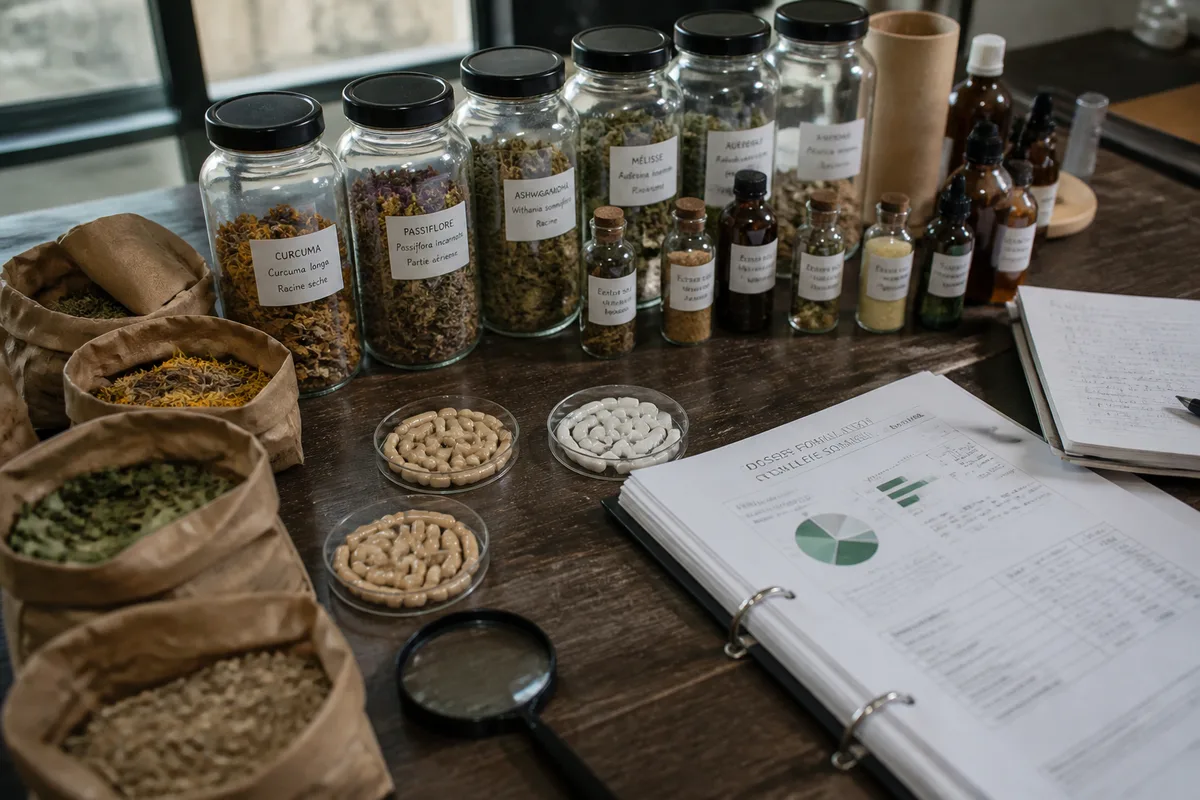
Compliance relies on a chain of responsibilities. The manufacturer controls the formula and production, the importer must check the product coming from a third country, and the distributor must verify that they are selling a properly identified and documented product, especially when warning signs appear.
| Actor | Priority checks | Risk in case of omission |
|---|---|---|
| Manufacturer | Formula, suppliers, analyses, label, and quality file | Non-compliant product or information |
| Importer | Origin, ingredient status, documents, and responsible operator | Entry of a non-compliant product into the French market |
| Distributor | Label, batch, supplier, withdrawal, and storage | Continued sale of a reported or irregular product |
| Online seller | Product sheet, claims, seller identity, and traceability | Misleading commercial communication or insufficient traceability |
Quality, self-checks, and HACCP method
Operators must organize self-checks adapted to identified hazards: contaminants, botanical identity errors, inconsistent dosage, allergens, microbiological contamination, or labeling defects.
The HACCP method helps identify hazards and control points in the process. It does not replace specific obligations related to ingredients, claims, or declarations.
Documents must remain accessible.
Controls and nutrivigilance
Controls may focus on actual composition, labeling, advertising, traceability, and marketing conditions. Reports of adverse effects feed into nutrivigilance, notably through Anses.
A report calls for an evaluation. It does not, by itself, automatically attribute an effect to the product or an ingredient.
Comparison: declaration, authorization, and control
These three concepts correspond to different stages in the product’s life. Confusing them either leads to overestimating the scope of a declaration or imagining a prior authorization procedure similar to that for medicines for all dietary supplements.
| Concept | What it is used for | What it does not allow to conclude |
|---|---|---|
| Declaration | Inform the administration of the market launch | That the product has been validated line by line |
| Specific authorization | Comply with certain regimes related to the composition | That all supplements are subject to a marketing authorization (MA) |
| Control | Verify the conformity of the product or communication | That the absence of control equates to conformity |
In this comparison, the declaration is the basic formality. The pharmaceutical marketing authorization does not constitute the applicable model for all dietary supplements.
Common mistakes to avoid in 2026
Errors observed in compliance often stem from a documentary shortcut: a foreign label is copied as is, a claim found on a social network is copied, or a declaration is interpreted as an administrative green light.
- Confusing declaration and validation. A declaration via Compl’Alim informs the administration, while the operator remains responsible for compliance. Keep the formula analysis and supporting documents.
- Copying a foreign claim. A promise authorized in a third country does not automatically become acceptable in France. Check the European regulation and the applicable register.
- Forgetting the form of the ingredient. The name of a plant or a vitamin is not enough: the part used, the extract, and the chemical form can alter the analysis.
- Presenting a scientific opinion as a prohibition. An ANSES opinion clarifies the health risk; you must look for the legal text that may set an obligation.
- Neglecting online sellers. A sales page, a video, or a sponsored post remains commercial communication subject to rules on claims.
A readable label is not enough.
How to verify the compliance of a dietary supplement: the steps
The verification must follow the actual order of marketing: identify the formula, qualify the ingredients, check the label, examine the claims, make the declaration, then organize the follow-up. This method avoids correcting an advertisement when the problem already comes from the status of an ingredient.
- Describe the formula. List each substance, its form, its quantity per serving, its supplier, and its claimed function.
- Check the status of the ingredients. Consult French and European texts, applicable lists, conditions of use, and possible Novel Food status.
- Control safety. Look for risks related to contaminants, known interactions, sensitive populations, and necessary warnings.
- Proofread the label. Compare the denomination, quantities, daily portion, precautions, batch, durability, and operator identity.
- Verify each claim. Check the exact wording, graphic context, digital media, and the possible presence of a therapeutic promise.
- Declare and archive. Complete the procedure via Compl’Alim when the product is on the French market, then keep proofs, label versions, and supporting documents.
- Organize follow-up. Plan the management of complaints, reports, withdrawals, recalls, and regulatory monitoring.
For a mushroom-based product, the species identity, the part used, and the form of the extract deserve particular attention; this analysis of the quality of mushroom-based formulas can complement documentary verification.
When to seek expert advice
Expert advice is relevant when an ingredient has an uncertain status, when a plant is subject to a recent measure, when a claim relates to a disease, or when the product targets children, pregnant women, or people undergoing treatment.
The pharmacist can help identify a usage incompatibility. The lawyer or food law consultant checks the qualification, the label, and the communication. For a binding decision, the official source remains a priority.
Calendar and sources to monitor in 2026
Regulatory monitoring must distinguish three levels: texts already applicable, officially announced measures, and projects still subject to modification. As of August 27, 2026, no general ban on all dietary supplements should be presented as established without an official published text.
Priority sources
- Ministry of Agriculture: definition, French framework, and information on dietary supplements.
- Ministry of Economy: consumer information and measures concerning certain products.
- Anses: health opinions, nutrivigilance, and risks related to certain uses.
- EFSA: scientific data and European framework for dietary supplements.
- Synadiet: useful sectoral reading, to be cross-checked with official texts.
The DGAL and Compl’Alim must be consulted for the declaration procedure. Légifrance is used to verify the French decree; EUR-Lex allows finding European regulations and directives in their applicable version.
Note the date of each verification.
Frequently asked questions about dietary supplement regulations in 2026
Will dietary supplements be banned or heavily restricted in 2026?
No general ban can be asserted without an official text. Specific ingredients or products may, however, be subject to restrictions, bans, or special usage conditions.
Does a new European rule automatically apply in France?
A European regulation is directly applicable under the conditions provided by its text. A directive must be transposed, whereas a scientific opinion or recommendation does not automatically have the same legal scope.
How to verify if a claim is authorized?
Search for the wording within the framework of Regulation (EC) No 1924/2006 and check its conditions of use. A similar claim, more spectacular or associated with a disease, may alter the analysis.
Are products sold online subject to the same rules?
Yes, online sales remain subject to safety, labeling, traceability, and commercial communication rules. A marketplace or social network does not create an exemption regime.
What to do if a label seems non-compliant?
Do not consume the product if there is serious doubt about its identity or safety, keep the packaging and batch, then seek advice from a pharmacist or report the situation through the appropriate official channels. A professional can also verify the label and claims.
Useful sources to consult
Official sources do not all answer the same question: the DGAL deals with market placement, the DGCCRF controls the fairness of information, and Anses provides health expertise. European and French texts must be read in their version in force at the time of the decision.
| Source | Useful data | Practical use | Watchfulness |
|---|---|---|---|
| DGAL and Compl’Alim | Declaration procedure | Prepare marketing in France | The declaration does not imply automatic approval |
| Légifrance | Decree No. 2006-352 | Check French law | Verify the applicable version |
| EUR-Lex | European texts | Review regulations and directives | Differentiating regulation, directive, and opinion |
| Anses | Opinions and nutrivigilance | Assess a reported health risk | An opinion is not always a ban |
| DGCCRF | Consumer information and controls | Check commercial practices | Also examine digital media |
What to remember for 2026
French regulation of dietary supplements remains based on direct responsibility of operators: verify the formula, qualify the ingredients, comply with labeling, regulate claims, declare the product, and monitor its safety after marketing.
In 2026, the correct approach is to separate the applicable text, the announcement, and the scientific opinion. This distinction avoids false alarms as well as overly quick approvals.
For a specific formula, check the current version of texts with DGAL, Compl’Alim, Légifrance, EUR-Lex, DGCCRF, Anses, and EFSA before any commercial decision.
(function(){
var ov=document.getElementById(‘magic-lb’);if(!ov)return;
var img=ov.querySelector(‘img’),btn=ov.querySelector(‘.magic-lb-close’);
function open(src){img.src=src;ov.classList.add(‘open’);document.body.style.overflow=’hidden’}
function close(){ov.classList.remove(‘open’);img.src=”;document.body.style.overflow=”}
document.addEventListener(‘click’,function(e){
var a=e.target.closest(‘a.magic-img-link’);
if(a){e.preventDefault();open(a.getAttribute(‘href’));return}
var i=e.target.closest(‘.wp-block-image img’);
if(i&&!e.target.closest(‘a’)){e.preventDefault();open(i.currentSrc||i.src)}
});
ov.addEventListener(‘click’,function(e){if(e.target===ov||e.target===btn)close()});
document.addEventListener(‘keydown’,function(e){if(e.key===’Escape’)close()});
})();
